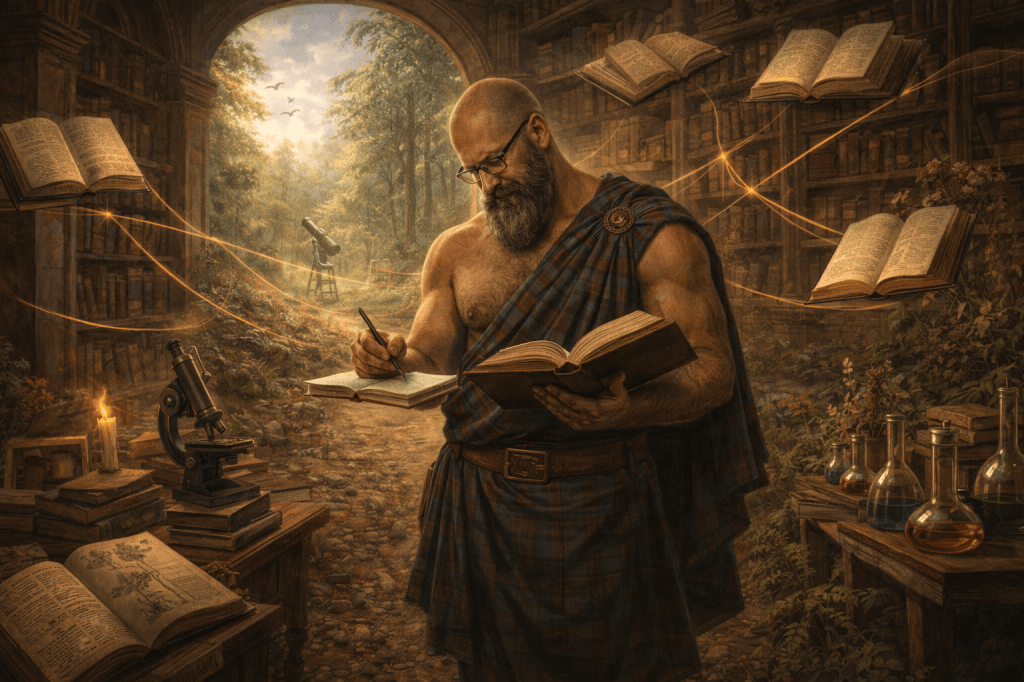
Prelude – The Nature of Connection
I have never seen the world as a collection of isolated subjects, but as one continuous organism of understanding. Every science, every craft, every philosophy hums with the same current. They differ in language, but not in essence. Where others see partitions, I see bridges. The veins of knowledge branch outward, yet all draw from the same heart.
To me, the act of learning is not an academic pursuit—it is biological. Nature does not separate the chemical from the physical, nor the living from the mechanical. It evolves through dialogue between them. The tree is not in conflict with its roots or leaves; the soil, air, and light are not competitors but collaborators in a single metabolism of being. My mind functions much the same way. When I study governance, I hear echoes of ecology; when I consider ethics, I glimpse the structure of a cell.
This is the nature of connection—the quiet recognition that everything informs everything else. Understanding becomes a form of listening: not to one voice, but to the harmony beneath the noise. To learn in this way is to take part in the oldest conversation in the universe, the one matter has been having with itself since the first atom chose to bond instead of drift apart.
The Problem of Mastery
Civilization loves to reward the specialist. We celebrate the master of a single domain—the physicist fluent in particles but not poetry, the surgeon who knows anatomy but not the soul that animates it. Mastery promises control, certainty, and recognition. Yet, there is a hidden cost: the narrowing of perception. To focus too tightly on one detail is to risk blindness to the pattern it inhabits.
This is not a flaw of intellect but of design. Our culture trains minds to burrow rather than to branch. Education divides what nature keeps intertwined, and we mistake segmentation for sophistication. When the biologist forgets philosophy, when the economist forgets ecology, when the theologian forgets the body, wisdom becomes fragmented. The result is precision without perspective—knowledge that can dissect the atom but not understand its consequence.
True mastery should illuminate connection, not obscure it. A mind confined to one chamber of expertise may produce genius within that space, but it cannot sense the tremors passing through the walls. The great crises of our age—ecological, moral, political—did not arise from ignorance, but from knowledge divorced from context. We mastered the parts and lost sight of the whole.
Mastery without relation is a form of amputation. It creates brilliance without empathy, efficiency without ethics, and progress without meaning. To see the world rightly again, we must learn to weave what we once severed—to become students not just of subjects, but of the symphony between them.
The Polymathic Stance
To be called a “jack of all trades” has long carried an insult hidden within the praise. It implies breadth without depth, curiosity without rigor. Yet the phrase was never meant to wound—it was coined to describe minds that could inhabit many crafts, thinkers who saw the kinship between disciplines rather than the walls dividing them. The polymath does not scatter attention; they cultivate synthesis.
To think polymathically is to hold a kind of double vision—to see both the tree and the forest at once. It requires humility before complexity and delight in translation. Where the specialist deepens the well, the polymath connects the aquifers. It is not about knowing everything, but about sensing how everything fits together. The goal is coherence, not conquest.
The polymath stands at the crossroads of knowledge, fluent enough in each dialect to recognize their shared grammar. A sculptor’s understanding of form can clarify a biologist’s perception of structure; a philosopher’s logic can refine an engineer’s design. Every insight ripples outward. To walk this path is to become a bridge—an interpreter between the sciences, the arts, and the unseen metaphors that bind them.
In the modern world, this stance feels almost rebellious. It resists the industrial model of learning that carves the human mind into departments. Yet the polymath’s defiance is gentle. It does not overthrow; it unites. It invites the world to remember that intellect, like nature, thrives on diversity. The wisdom of the generalist is not in knowing all things, but in seeing that all things already know each other.
The Method of Integration
Integration begins not with knowledge, but with observation—an awareness that every idea casts reflections across disciplines. I have never sought to master a single field, but to study the light that passes between them. When physics describes energy, philosophy whispers of will. When biology explains adaptation, ethics recognizes compassion. The borders between subjects are administrative conveniences, not truths of nature.
My process is neither accidental nor mystical. It is methodical empathy: to enter each discipline with respect for its internal logic, and then to translate that logic into the language of another. The insights that survive translation are the ones that contain universal patterns. Through this process, one begins to recognize repetition across scales—the way neural networks echo social networks, how the flow of capital mirrors the flow of blood, how civic health depends on the same feedback loops that govern ecosystems.
This is not analogy for its own sake. It is a working hypothesis of unity. When an idea proves itself in multiple domains, it graduates from theory to principle. The Circle system itself was born from this recognition. Governance, I realized, could behave like a biological process: adaptive, reciprocal, and self-healing. What is law but the immune system of civilization? What is education but its genetic replication? What is ethics but the circulatory rhythm that keeps its organs alive?
To integrate is to listen for resonance—the hum that arises when truth vibrates in more than one key. The method does not promise perfection; it promises coherence. In this sense, I am not a builder of systems, but a gardener of connections. My craft is not invention—it is pollination.
The Living Framework
From this method of integration, the framework emerged not as a theory, but as an organism. The Utopian Society is not built from abstractions—it grows from observation. It is alive in structure and temperament, governed by the same logic that animates a forest or a body. Its Circles are organs; its Charters, strands of DNA; its citizens, living cells in the metabolism of civilization.
The Living Framework assumes that survival is not enough. Continuity must be paired with consciousness. The purpose of governance, then, is not to enforce order, but to maintain equilibrium—to respond to imbalance as a body responds to fever: not with punishment, but with healing. Authority becomes less about command and more about circulation, ensuring that energy—be it labor, knowledge, or care—moves freely throughout the system.
Each Circle, though distinct in purpose, depends on the others for vitality. Contribution supplies the muscle, Learning the brain, Custodianship the memory, Healing the regenerative tissue, and Harmony the endocrine balance. Together they compose a self-aware organism, capable of adaptation and repair. The Circle of Learning, in particular, functions as the neural network, transmitting information through feedback and renewal, ensuring that the entire system remains conscious of itself.
To design a civilization in this way is to mirror life’s oldest architecture. Nature perfected governance long before humanity invented politics. In adopting its patterns, we do not imitate the wild—we remember it. A society that learns as it lives, and lives as it learns, becomes not a machine of policy but a breathing intelligence. It is governance elevated to biology, and biology ennobled to philosophy.
Reflection – The Elegance of Relation
In the end, every pursuit of understanding returns to the same revelation: relationship is the true unit of knowledge. Nothing exists alone. A law of physics is only meaningful when it meets the world it describes; an act of compassion only real when it touches another. To think in relationships is to think as the universe does.
Our culture mistakes accumulation for wisdom. We hoard information as if data were nourishment. But knowledge without relation is inert. It has no current, no warmth, no gravity to pull meaning into orbit. Wisdom begins only when information becomes connection—when one idea finds resonance in another, and together they produce understanding.
I have come to see my own work not as invention, but as recognition. The Circles, the Charters, the Corpus—they are expressions of a pattern that was already here. Nature whispered it in the growth of coral, in the branching of neurons, in the equilibrium of ecosystems. I merely translated its grammar into the language of civilization.
Perhaps that is the final purpose of a polymath: not to master many things, but to reveal the unity beneath them. To look at complexity and see coherence. To remember that the mind, like the cosmos, was never meant to be compartmentalized. Its beauty lies in entanglement.
To know one thing deeply is mastery. To know how all things relate is wisdom.

 Utopian Society
Leave a comment