Introduction
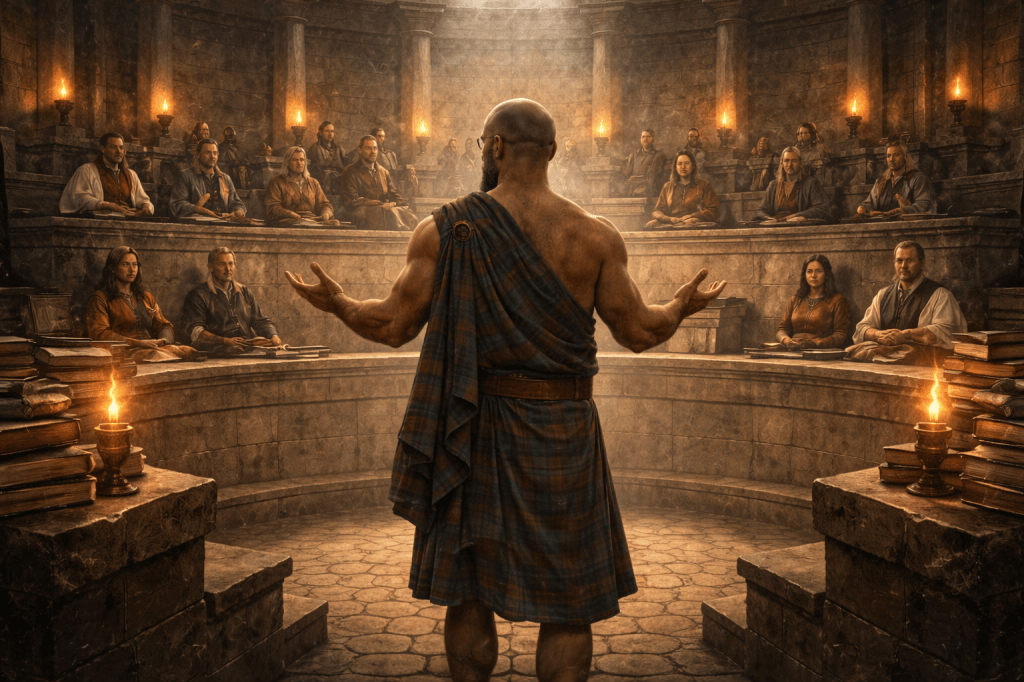
The Utopian Corpus was never conceived as a flawless monument, sealed away from critique, nor as a doctrine immune to question. Instead, it begins from a recognition that all human design—whether systems of governance, codes of ethics, or philosophies of society—is provisional. Every framework is subject to the slow erosion of time, to the shifts of circumstance, and to the inevitable oversights of those who authored it. The Corpus therefore affirms, with deliberate humility, that no vision for human society can claim to be final. It acknowledges openly that wisdom is not frozen but alive, and that strength is not found in refusing critique, but in embracing it as the very crucible by which resilience is forged. Just as the Declaration of Revision calls upon future generations to continue the work of refinement, this section goes further, subjecting the Corpus itself to trial by the greatest judges history has to offer: the philosophers, the statesmen, and the spiritual authorities who have shaped the course of civilizations.
The purpose of this self-critique is twofold. First, it is an act of honesty: an admission that the Corpus cannot claim authority without being tested against the accumulated wisdom and errors of the past. Second, it is a demonstration of courage: a willingness to welcome scrutiny rather than suppress it, to stand openly in the arena of ideas and allow itself to be weighed and measured. Where weaknesses are revealed, they become opportunities for correction. Where strengths are confirmed, they shine brighter for having survived examination. The intention is not to declare final perfection, but to model a culture of constant refinement and resilience.
To achieve this, the Corpus is examined from three great vantage points of human history. The first is the lens of ancient philosophy, where the voices of Socrates, Plato, Aristotle, Epicurus, the Stoics, and Cicero are summoned as interlocutors. These figures, though separated from us by centuries, remain among the most enduring architects of political thought. They asked the timeless questions—what is justice, what is virtue, what is the good life—and their challenges must be answered if any new framework is to claim legitimacy. Their doubts and insights are rehearsed not to dismiss them, but to place the Corpus under the same sharp light of reason that illuminated the earliest explorations of governance.
The second vantage point is the Enlightenment era, and in particular the voices of the Founding Fathers of the United States—Jefferson, Hamilton, Madison, Franklin, Adams, and others who built one of the world’s most influential constitutional experiments. Their achievements and contradictions still echo across modern governance. They wrestled with liberty and order, with faction and representation, with virtue and power. In this section, their imagined critiques are answered: does the Corpus learn from their successes while avoiding their hypocrisies? Does it improve upon their designs for equality, or stumble over the same blind spots of exclusion? The confrontation with these figures ensures that the Corpus does not float free of history, but shows itself aware of the constitutional traditions that preceded it.
The third and final vantage point is religion itself—the oldest and most pervasive form of human governance. Long before secular constitutions, religion governed societies with ritual, law, and the weight of the divine. From the halls of the Vatican to the mosques of Mecca, from the Torah to the Vedas, from the teachings of Taoist sages to the ceremonies of indigenous traditions, religion provided order through promises of salvation and threats of damnation. To stand against this ancestral model is no small test, for it means confronting authority systems that commanded obedience for millennia. In this section, the Corpus both acknowledges the enduring moral insights of faith traditions—justice, stewardship, compassion—while rebutting their reliance on fear, hierarchy, and coercion as instruments of control. This theological critique demonstrates how the Corpus respects humanity’s spiritual heritage while breaking the chains of its abuses.
By presenting these critiques openly, and by meeting them with reasoned rebuttals, the Corpus demonstrates that it does not fear opposition. On the contrary, it anticipates it. Criticism is not treated as an enemy but as an ally, a sharpening stone against which clarity is honed. This section, therefore, is less a defense than a ritual of testing: a trial by fire, where the roots of this vision are exposed to storms drawn from the deepest wells of human thought and tradition. That they may bend and not break is proof not of perfection, but of vitality. The intent is not to declare an untouchable system, but to demonstrate resilience, awareness, and readiness to evolve—qualities more precious than finality. In this way, the Corpus seeks not only to endure but to grow, sustained by the humility to be questioned and the courage to be refined by those yet to come.
Ancient Philosophical Critique
Introduction
The Corpus must first be weighed against the minds who laid the foundations of political philosophy—not only those who designed ideal states, but also those who lived philosophy with their bodies, distrusted certainty, and stripped life down to its essentials. These figures—Socrates, Plato, Aristotle, Epicurus, the Cynics, the Stoics, the Skeptics, and Cicero—do not represent a single lineage, but a tension-filled conversation about how human beings ought to live together.
They did not write constitutions as we understand them today, yet they wrestled with the same enduring dilemmas: what is justice, what is virtue, how should societies be ordered, how much structure is necessary, and where does certainty become danger? Some sought harmony through design, others through discipline, others through radical simplicity, and still others through suspended judgment. Their disagreements are as instructive as their conclusions.
The critiques imagined here are not hostile dismissals, but rigorous questions posed from radically different postures of life. By passing through this full spectrum of ancient voices—the civic architects, the barefoot critics, and the skeptics of dogma—the Corpus demonstrates both continuity with human tradition and a conscious divergence from its failures. To invite these voices to the table is to test the Corpus not only against reason, but against courage, humility, and lived integrity: the oldest and sharpest steel humanity has ever forged.
Socrates
Critique: Socrates would demand clarity above all. He might ask: Have you defined justice, or have you only described its procedures? Without a precise definition, the Corpus risks being a shell of rules without a heart of virtue. He might press further: Is it enough to say that justice is harm and restoration? What if citizens disagree on what constitutes harm? What if restoration feels incomplete to the victim or unjust to the accused? He would also remind the Corpus of the danger of assuming knowledge not truly possessed: How will you prevent citizens from mistaking confidence for wisdom? Is not the danger of hubris alive even in your Circles?
Rebuttal: The Corpus acknowledges that justice cannot be reduced to a single definition carved in stone. Instead, it roots justice in a dynamic interplay between harm and restoration, allowing definitions to evolve through dialogue, evidence, and shared deliberation. Where Socrates worried about false certainty, the Corpus seeks to embed uncertainty as a safeguard: no claim is beyond question, and no doctrine is exempt from revision. The Circle model decentralizes authority precisely to prevent hubris, ensuring that no single voice can dominate or claim final wisdom. Knowledge remains provisional, always subject to scrutiny, and humility is built into the very bones of governance.
Plato
Critique: Plato might question whether the Circles avoid the dangers of democracy sliding into chaos. He would ask: If all are given equal voice, how do you prevent the rise of demagogues? How do you guard against appetites overruling wisdom? He might argue that democracy unchecked inevitably descends into disorder, and from disorder arises tyranny. Without guardians trained to know the Good, Plato might warn, the Corpus risks steering itself by the desires of the many rather than the truth of the few.
Rebuttal: The Corpus counters that philosopher-kings create hierarchy and exclusion, concentrating wisdom in the hands of the few and silencing the many. Instead of philosopher-kings, the Corpus seeks philosopher-citizens: all are educated in civic duty, evidence, and restoration, cultivating wisdom across the body of society. Rather than depending on a ruling class, the Corpus invests in the growth of every mind. Demagoguery is restrained not by silencing the masses but by enforcing transparency, by mandating broad participation, and by ensuring constant circulation of representatives. Appetite is balanced by reason because reason is taught to all, not hoarded by the elite. In this way, the Corpus attempts to answer Plato by democratizing the guardianship of wisdom itself.
Aristotle
Critique: Aristotle would examine the Corpus through his lens of naturalism. He might ask: Does your tree analogy reflect true balance, or does it risk romantic metaphor over practical function? He would look to see whether the Circles truly embody his ideal of a “polity,” the balanced middle between oligarchy and democracy. Aristotle might worry that in giving all citizens equal credit for their labor, the Corpus leans too heavily into egalitarianism, potentially sacrificing efficiency or excellence in the pursuit of equality.
Rebuttal: The Corpus uses the tree not as decoration but as a genuine model of interdependence. Each branch, twig, and leaf has its role, and all thrive only in balance with the whole. The Circles echo Aristotle’s polity by blending variety of function with equality of worth. The Corpus does not deny excellence; it insists that excellence can flourish without hierarchy, and that efficiency can align with dignity. Far from being sacrificed, excellence is amplified when every citizen has a place, and efficiency is safeguarded by diversity and redundancy. Authority is never absolute, but always rooted in service, ensuring balance rather than imbalance.
Epicurus
Critique: Epicurus might ask whether the Corpus has confused liberty with constant civic obligation. He could caution: Does mandatory voting and contribution rob citizens of the tranquil life? Is not freedom also the freedom from compulsion? He would warn that a society demanding too much risks sowing resentment, and that tranquility, not duty, is the highest good.
Rebuttal: The Corpus replies that obligation here is not compulsion but participation. Civic duty ensures flourishing for all, creating the stability that makes tranquility possible. Epicurus sought freedom from fear of gods and tyrants; the Corpus offers freedom from poverty, exploitation, and neglect. Citizens contribute not because they are coerced but because contribution is the soil in which peace grows. Leisure and restoration are built into the system, ensuring that duty never becomes chains. In answering Epicurus, the Corpus affirms that tranquility is not lost but preserved, safeguarded by justice and equality.
The Cynics
(Crates of Thebes & Hipparchia of Maroneia)
Critique: The Cynics would approach the Corpus not from the comfort of theory but from the raw exposure of lived life. Crates and Hipparchia might accuse the Corpus of unnecessary complexity, asking why so many structures are required when virtue can be lived plainly. They would question whether formal Circles, Charters, and ledgers risk recreating the very social theater they once mocked in the streets of Athens. They might also provoke discomfort by asking whether the Society truly accepts bodily honesty and equality, or whether it merely tolerates them so long as they remain orderly and discreet.
The Cynics would press hardest on shame. They would ask whether any trace of propriety remains that still privileges appearance over truth, comfort over authenticity, or reputation over integrity. If dignity is universal, they would ask, why should any natural act require concealment or justification at all?
Rebuttal: The Corpus answers that Cynic insight is not rejected, but scaled. Where Crates and Hipparchia lived virtue as personal defiance, the Corpus seeks to make such freedom survivable for entire populations. Structures exist not to suppress authenticity, but to protect it from coercion, exploitation, and unequal power. The Corpus agrees with the Cynics that property, status, and inherited privilege distort human relations, and therefore abolishes them at the civic level rather than asking individuals to heroically renounce them alone.
Where the Cynics dismantled shame through provocation, the Corpus dismantles it through normalization. Bodily honesty, sexual dignity, and equality are not acts of rebellion here, but assumed conditions of health. The Society does not ask citizens to perform defiance in public squares; it removes the need for defiance altogether. In this way, the Corpus extends Cynic courage into collective design, ensuring that what once required personal sacrifice becomes a shared baseline of dignity.
Zeno of Citium
(Foundational Stoicism)
Critique: Zeno, founder of Stoicism, imagined a society governed not by courts, money, or temples, but by reason and natural law. He might challenge the Corpus by asking whether its institutional scaffolding is truly necessary if citizens are educated in virtue. Why not trust reason alone? Why not rely on self-governance guided by nature, as his ideal polis envisioned? Zeno could warn that systems, however well designed, risk dulling individual moral responsibility by externalizing virtue into procedure.
Rebuttal: The Corpus responds that it is closer to Zeno’s vision than it may appear. Like Zeno’s imagined polis, it rejects hierarchy, inherited power, and divine mandate. It grounds law in nature, evidence, and reason rather than revelation. Where it diverges is in its acknowledgment of human variability. The Corpus does not assume universal sagehood; it assumes fallibility.
Institutions in the Society do not replace virtue, but scaffold it—providing resilience when individuals falter and continuity across generations. Education cultivates Stoic endurance and rational reflection, while restorative systems prevent moral failure from becoming permanent harm. In this sense, the Corpus can be read as Zeno’s city made durable: a Stoic ethic embodied not only in individuals, but in shared structures that protect reason from erosion by crisis, fear, or inequality.
Sextus Empiricus
(Skepticism)
Critique: Sextus Empiricus would direct his scrutiny not at any single clause, but at the Corpus as a whole. He might ask whether its confidence in design risks becoming a new form of dogma. Even evidence, he would remind us, is interpreted through human lenses. He would caution that certainty breeds arrogance, and that systems convinced of their own correctness often become blind to their failures. How does the Society ensure that today’s truths do not become tomorrow’s unquestioned orthodoxy?
Rebuttal: The Corpus meets this challenge by embracing Skepticism as a governing principle rather than a threat. It does not claim final truth, but provisional adequacy. Its cycles of revision, transparent appendices, and evidentiary requirements institutionalize doubt as a civic virtue. Where Sextus suspended judgment to preserve tranquility, the Corpus suspends finality to preserve justice.
Action is not paralyzed by uncertainty; it is guided by it. Decisions are made, but always with the expectation of review, correction, and improvement. In this way, Skepticism becomes not a withdrawal from responsibility, but a safeguard against tyranny. The Society does not say “this is true forever,” but “this works given what we know now.” That posture—humble, alert, corrigible—is the living legacy of Skeptic thought embedded into civic design.
The Stoics
(Marcus Aurelius, Seneca)
Critique: The Stoics might ask whether the Corpus prepares citizens to endure hardship. They would ask: If systems fail, if nature strikes, if chaos intrudes, will your society still stand? Or does it rely too heavily on design, forgetting the resilience of the soul? They would caution that no system, however well designed, can eliminate misfortune, and that individuals must cultivate inner strength.
Rebuttal: The Corpus embraces Stoic wisdom by embedding resilience into both structures and citizens. Circles distribute power so no single collapse is fatal; restoration ensures that even when harm is done, renewal is possible. At the same time, Stoic endurance is honored in education: citizens are taught acceptance of nature’s trials, but also responsibility to rebuild. The Corpus does not promise to abolish suffering—it promises to prevent unnecessary suffering and to equip citizens with strength when hardship comes. It weds Stoic endurance with communal solidarity, ensuring that the soul and the structure both know how to endure.
Cicero
Critique: Cicero would approach as a Roman statesman and orator. He might ask: Does the Corpus enshrine natural law and universal reason, or does it risk relativism by grounding everything in evidence? How can law be stable if its foundation is not divine? How does it preserve continuity of tradition without religion’s sanction? He might fear that law without gods is law without roots.
Rebuttal: The Corpus affirms natural law but redefines it as discoverable through evidence rather than revelation. Reason remains universal, but its applications are flexible, adapting to new circumstances. Continuity is preserved not through divine decree but through transparency and revision, binding each generation to care for the structure while freeing them from fossilized doctrine. Tradition is honored as inheritance, not as chains. Cicero’s vision of a republic is acknowledged, but in the Corpus it is freed from empire, freed from priesthood, and restored to citizens themselves.
Conclusion
By passing through this imagined symposium, the Corpus demonstrates that it has not forgotten the questions of antiquity, nor confined itself to their most comfortable forms. It has been weighed not only against demands for clarity, wisdom, balance, tranquility, endurance, and reason, but also against traditions that distrusted certainty, rejected pretense, and lived philosophy without shelter.
The answers it offers are not final, yet they show that the system is neither naïve nor unexamined—neither architecturally rigid nor philosophically timid. In dialogue with the ancients, the Corpus affirms itself as a continuation of humanity’s long conversation about justice: rooted in tradition, tempered by skepticism, and unafraid to embody its principles in lived reality. It presents itself not as a break from the past, but as a branch of the same great tree of inquiry, nourished by old roots, pruned by doubt, and bearing new fruit.
Founding Fathers Critique
Introduction
Having withstood the questions of antiquity, the Corpus must also be examined through the eyes of the Enlightenment and the early architects of modern constitutional governance. The Founding Fathers of the United States—Jefferson, Hamilton, Madison, Franklin, Adams—are not summoned here as heroes to be idolized, but as rigorous critics whose contradictions highlight the difficult stakes of liberty, equality, and civic duty. Their imagined responses help test whether the Corpus has absorbed their insights while avoiding their failures. By engaging them, the Corpus not only shows continuity with the Enlightenment project of reason and rights but also demonstrates where it consciously diverges to achieve what they could not.
Thomas Jefferson
Critique: Jefferson would celebrate the Corpus for its emphasis on liberty, transparency, and self-rule, but he would recoil at its egalitarian credit system and its codification of sexual dignity. He might ask: Does universal equality cheapen excellence? Do you not risk moral decline by stripping intimacy of sacred restraint? He might further press: If liberty requires independence of property and land, how do you secure virtue without individual ownership? Finally, he would be forced to confront his own hypocrisy: If all men are equal, why then did you tolerate slavery and deny equality to women?
Rebuttal: The Corpus answers Jefferson by insisting that equality does not diminish excellence, but sets the fertile soil upon which excellence may truly flourish. Dignity of the body and freedom of intimacy are not license or decline, but recognition that shame and silence are chains. The Corpus counters Jefferson’s agrarian vision by stating that independence need not rely on property but on equal civic credit. Where Jefferson faltered—proclaiming equality while enslaving others—the Corpus is explicit: there is no liberty without universality, no dignity for some without dignity for all, and no future secured on hypocrisy.
Alexander Hamilton
Critique: Hamilton would admire the structural clarity and fiscal discipline of the Corpus, but he would doubt its rejection of hierarchy. He might ask: Without centralized power and economic incentives, how do you secure stability? Can equal credits truly replace markets and capital? Will citizens strive without competition? He would suspect that egalitarianism risks fragility, and that states organized without hierarchy may crumble before stronger, more aggressive nations.
Rebuttal: The Corpus acknowledges Hamilton’s concern for stability but rejects the notion that hierarchy and capital are the only anchors of security. Stability comes not from concentration but from distribution, where no single collapse can ruin the whole. The egalitarian credit system secures equality while still rewarding contribution, ensuring vitality without exploitation. Against foreign powers, the Corpus asserts that unity is preserved by shared dignity and mutual trust, not by fear or wealth hoarded by a few. The Corpus transforms Hamilton’s energy of ambition into collective resilience, channeling brilliance into communal strength rather than individual dominance.
James Madison
Critique: Madison, architect of checks and balances, would probe the Corpus for safeguards. He would ask: How do you prevent factions from dominating Circles? How do you guard against majority tyranny? Does mandatory voting inflame factionalism, forcing decisions upon unwilling participants? He would fear that direct participation could allow popular passion to trample rights and destabilize order.
Rebuttal: The Corpus responds that Circles are designed to prevent entrenchment: representatives circulate, roles rotate, and decisions remain transparent. No authority lasts long enough to ossify, and no group monopolizes for generations. Factions are further diluted because participation is both mandatory and equal; no bloc can dominate without being balanced by all others. Popular will is not unchecked but yoked to restorative duty and constitutional principles. In this way, majority appetite cannot consume minority dignity, and liberty is preserved without ceding authority to elites.
Benjamin Franklin
Critique: Franklin, ever pragmatic and wry, would applaud the Corpus’ emphasis on education, contribution, and civic duty. Yet he would raise questions of practicality: Can lofty ideals survive ordinary human vice? How will you counter laziness, corruption, or self-interest? What if citizens simply exploit the system? He would also challenge the integration of sexual dignity into governance, asking whether society is truly mature enough to treat it without scandal or abuse.
Rebuttal: The Corpus concedes Franklin’s concern but insists that corruption is not prevented by cynicism but by design. Transparency, accountability, and restorative justice blunt the edge of self-interest. Laziness and neglect are met not with condemnation but with equitable redistribution of duty, ensuring that no one can permanently evade responsibility. As for sexual dignity, the Corpus holds that silence and repression breed abuse, whereas openness breeds honesty. A society that dares to speak truthfully about the body is one less likely to be enslaved by hypocrisy or to tolerate exploitation in the shadows. Franklin’s wit would find its place not in mocking these ideals, but in reinforcing their honesty.
John Adams
Critique: Adams, wary of unrestrained democracy, would ask: Does mandatory civic duty risk coercion? How do you balance freedom with obligation? Will not citizens grow weary of constant participation? He would fear that exhaustion and resentment could undermine stability, leading to chaos.
Rebuttal: The Corpus replies that obligation here is not tyranny but the price of liberty shared equally by all. Mandatory participation prevents apathy, suppresses disengagement, and ensures resilience of governance. Fatigue is offset by rhythm: duty is always matched by restoration, and no citizen is ever trapped in perpetual service. Civic responsibility is framed not as an imposition but as an honor, ensuring that equality remains protected against creeping hierarchy. The Corpus embraces Adams’ warning but turns it into discipline, showing that freedom and duty can sustain one another rather than compete.
Conclusion
By confronting the Founding Fathers, the Corpus shows that it has inherited their central questions—liberty, representation, stability—but refuses their compromises of exclusion and hierarchy. Where Jefferson declared equality but preserved slavery, the Corpus closes the gap with universality. Where Hamilton exalted central power and markets, the Corpus disperses authority and equalizes credit. Where Madison feared factions, the Corpus diffuses their strength by design. Where Franklin worried about corruption and vice, the Corpus answers with transparency and restorative mechanisms. Where Adams feared fatigue, the Corpus tempers duty with balance and dignity. In dialogue with the Founders, the Corpus proves itself both student and successor, extending their experiment while transcending their limits. It emerges not as a repudiation of their work but as its natural evolution, carrying forward their ambitions without repeating their hypocrisies.
Theology Critique
Introduction
Having stood under the questions of philosophy and endured the scrutiny of the Founding Fathers, the Corpus must now face the longest-lived and most pervasive system of governance humanity has ever known: religion. For millennia, laws were justified through divine command, obedience enforced by the fear of punishment after death, and order maintained through promises of paradise or threats of damnation. From the cathedrals of Rome to the mosques of Mecca, from the Torah to the Vedas, from the teachings of Confucius and Laozi to the rituals of indigenous traditions, religion has been the ancestral body of authority, shaping morality, culture, and power. To measure the Corpus against theology is therefore to confront not just a belief system, but the very structure that governed humanity for centuries before secular constitutions ever arose.
The Vatican (Catholic Tradition)
Critique:
The Vatican, steeped in hierarchy and tradition, would likely condemn the Corpus on multiple grounds:
- Sexual Dignity: Codifying sex practitioners, bodily autonomy, and the sacredness of intimacy contradicts Catholic doctrine on chastity, celibacy, and sin.
- No Necessary Evil: Rejecting sin as inevitable undermines the doctrine of original sin, the backbone of Catholic soteriology.
- Epistemology: Evidence-based appendices displace revelation and scripture as ultimate authority.
- Authority: Decentralized governance destabilizes papal supremacy and the claim of apostolic succession.
Rebuttal:
The Corpus does not deny spiritual experience; it denies imposed hierarchy. It enacts values Catholicism preaches but often betrays—love, dignity, and truth. If God is truth, evidence-based governance fulfills rather than opposes faith. If Christ is love, then treating bodies and intimacy without shame resonates with his teaching. What the Vatican fears most is not heresy, but the erosion of control once fear and guilt are no longer its instruments of order.
Evangelical Protestantism
Critique:
Evangelical movements, especially in their American forms, would denounce the Corpus as godless, immoral, and corrosive to society. They would call its sexual liberty licentious, its egalitarian economics Marxist, and its absence of a deity nihilistic. Their focus would be on:
- Lack of divine authority as foundation of law.
- Rejection of sin as an unavoidable condition of humanity.
- Replacement of absolute biblical codes with evidence-based ethics.
- Threats to family norms and patriarchal structures.
Rebuttal:
The Corpus emphasizes accountability, restoration, and communal responsibility. Evangelicals claim these values but enforce them with fear of hell and the promise of heaven. The Corpus achieves them through civic duty and restorative design. In this way, it resonates more closely with Christ’s teachings of compassion, forgiveness, and care for the least of these than with fear-driven dogma.
Judaism
Critique:
Judaism, with its emphasis on covenantal law and centuries of halakhic tradition, would find the Corpus disconcerting. Critics might argue:
- That dismissing divine command undermines Torah as moral foundation.
- That communal law without God risks fragmentation and loss of coherence.
- That sacred rituals and remembrance risk being sidelined by secular evidence and procedural design.
Rebuttal:
The Corpus honors many Jewish values—justice, stewardship, remembrance, and communal obligation—while stripping away divine exclusivity. Like the rabbinic model of debate and reinterpretation, the Corpus thrives on constant review and refinement. It echoes the dynamism of Talmudic tradition but without gatekeeping rooted in divine mandate.
Islam
Critique:
Islam, as a religion deeply entwined with governance and law, would challenge the Corpus on several points:
- Sharia: By rejecting divine law, the Corpus denies God’s sovereignty and order.
- Community: Without shared faith, society risks moral collapse and fragmentation.
- Authority: Imams and jurists may see Circles as rival structures of legitimacy and divine interpretation.
Rebuttal:
The Corpus embodies values the Qur’an itself extols—justice, mercy, charity, stewardship, and accountability. While it refuses divine law, it enshrines principles Islam prizes. Restoration rather than punishment, stewardship rather than domination, transparency rather than secrecy—all reflect Qur’anic ethos translated into humanist design. Islam’s social heart resonates with the Corpus even as theological structures conflict.
Buddhism
Critique:
Buddhism, less dogmatic in governance, might critique the Corpus gently. Concerns could include:
- Lack of explicit spiritual cultivation alongside civic structures.
- Overemphasis on external systems rather than inner transformation.
- Risk of attachment to worldly design rather than transcendence and awakening.
Rebuttal:
The Corpus is consonant with Buddhist principles: harm is recognized, compassion guides response, cycles of suffering are interrupted through restoration. Where Buddhism emphasizes liberation from suffering through mindfulness and detachment, the Corpus emphasizes liberation from suffering through thoughtful design. They stand as parallel paths, not antagonists.
Hinduism
Critique:
Hindu traditions, with their blend of philosophy, ritual, and social order, might object that:
- The rejection of caste distinctions erases divine social duties (dharma).
- Sacred rituals and gods are sidelined in favor of secular evidence.
- The emphasis on equality clashes with hierarchical interpretations of karma and rebirth.
Rebuttal:
The Corpus resonates with Hindu values of stewardship, non-harm (ahimsa), and community duty, while discarding caste oppression and exclusion. Like Hindu philosophical schools, it encourages reflection, reinterpretation, and pluralism. It affirms growth and reincarnation not as fixed destiny, but as cycles of learning and becoming within civic life.
Sikhism
Critique:
Sikhism, rooted in devotion, equality, and community, might critique:
- The absence of divine name and prayer in civic life.
- The rejection of scriptural authority in favor of human reasoning.
Rebuttal:
The Corpus aligns with Sikh values of equality, service (seva), and justice. It enshrines dignity and contribution as civic duties, echoing the Sikh ethos of community kitchens (langar) and defense of the oppressed. Faith can persist and flourish within the society, but never as coercion.
Taoism and Confucianism
Critique:
- Taoists might argue that rigid systems disrupt natural flow (the Dao) and spontaneity.
- Confucians might argue that virtue requires hierarchical roles, filial piety, and ritual, not pure egalitarianism.
Rebuttal:
The Corpus embraces Taoist values of balance, natural order, and harmony, while ensuring systems remain flexible and adaptive. It resonates with Confucian ideals of virtue, duty, and harmony, but decentralizes hierarchy, making stewardship a collective act. In both cases, it honors wisdom while refusing to sanctify rigid control.
Indigenous and Animist Traditions
Critique:
Indigenous and animist traditions might critique the Corpus for overemphasis on human-made structures, neglecting spiritual relationships with land, ancestors, and spirits. They may argue that reverence cannot be fully codified.
Rebuttal:
The Corpus is deeply naturalist—it affirms reverence for earth, cycles, ancestry, and continuity. While it does not mandate belief in spirits, it honors relationships with land and community as sacred. Rituals of observance, seasonal festivals, and civic stewardship echo indigenous reverence for balance and continuity, without imposing singular doctrine.
Progressive Quakerism and Liberation Theology
Critique:
Quakers and liberation theologians might welcome large portions of the Corpus—equality, transparency, and restoration. Their critique would be that it stops short of embracing spiritual language explicitly.
Rebuttal:
The Corpus is not anti-spiritual; it is post-hierarchical. It honors equality and stewardship, resonating with Quaker meetings and liberation theology’s care for the oppressed. Faith is welcomed, but it is never compulsory, and never wielded as a tool of domination.
General Rebuttal: Religion as Ancestral Governance
Religion was humanity’s first government. Laws were justified by gods, obedience enforced by fear, and order maintained by promises of paradise or threats of damnation. The Corpus acknowledges this ancestry but refuses to repeat its errors. Governance must rest not on invisible threats but on visible evidence, not on eternal punishment but on tangible restoration, not on rigid hierarchy but on distributed stewardship. The Corpus honors what is enduring in religious tradition—community, reverence, moral concern—while discarding fear, secrecy, and domination.
The Corpus also invites dialogue with religions rather than silencing them. Individuals of faith can continue to practice freely, but without imposing belief through law. In this way, it carries forward the ethical gifts of religion while removing the chains of coercion.
Conclusion
Religious institutions will fear the Corpus not because it denies compassion, but because it denies their monopoly on defining it. The Corpus proves that dignity, truth, and restoration can be achieved without divine terror as guarantor. This does not erase faith; individuals may practice freely. What it erases is the use of faith as a chain, binding conscience to hierarchy. In this sense, the Corpus is less an enemy of religion than a liberation from its abuses, offering a future where goodness rests not on fear of God, but on the integrity of design and the flourishing of all people. It builds bridges to the values of every faith while dismantling the walls of control, inviting humanity to step beyond theocracy into a governance of shared evidence, equity, and compassion.
Self-Critique and External Rebuttal – Conclusion
The journey through self-critique has now passed through three monumental trials: the searching questions of ancient philosophy, the cautious warnings of the Founding Fathers, and the enduring authority of religion. Each vantage point represents a towering presence in human history, and each has pressed its own unique doubts upon the Corpus. Socrates demanded clarity and honesty, Plato feared disorder and demagoguery, Aristotle questioned balance and natural order, and Cicero sought law rooted in reason and continuity. Jefferson wrestled with liberty while trapped in hypocrisy, Hamilton demanded stability and hierarchy, Madison feared the corrosive power of factions, Franklin doubted whether ideals could withstand vice, and Adams trembled before the exhaustion of democracy. The Vatican defended hierarchy, Evangelicals feared moral collapse, Judaism and Islam defended divine law, Buddhism questioned attachment and design, Hinduism and Sikhism guarded tradition and devotion, Taoism and Confucianism spoke for balance and virtue, while indigenous traditions reminded humanity of its deep bond to land, spirit, and ancestry. Against them all, the Corpus has stood, not without vulnerability or imperfection, but with the strength that comes from openness, transparency, and willingness to respond.
The purpose of this exercise has never been to boast of victory over history’s critics or to parade triumphantly as if every challenge were easily dismissed. Rather, it is to demonstrate that no vision for human society can claim legitimacy without being weighed against those who came before. The Corpus does not silence these voices, nor pretend they never spoke. Instead, it brings them into dialogue, learning from their insights, embracing their wisdom, and confronting their blind spots. Where their concerns are justified, the Corpus acknowledges them and adapts accordingly. Where their errors are revealed, the Corpus marks them as warnings never to be repeated. In this way, critique becomes nourishment, strengthening the body of the Corpus, rooting it not in arrogance or fragile certainty, but in humility and resilience.
This section also serves as a mirror held up to the Declaration of Revision. Just as future generations are invited to amend, reshape, or even overturn parts of the Corpus in light of new evidence and new needs, so too has this generation dared to critique itself here. In doing so, the Corpus models the very culture it seeks to cultivate: one that does not fear correction but embraces it as a civic duty, one that sees critique not as weakness but as the heartbeat of growth. A society that refuses critique inevitably stagnates, calcifying into brittle dogma. A society that welcomes critique grows resilient, supple, and enduring. Thus the Corpus moves into its subsequent Charters and Codices not as a brittle doctrine of unyielding rules, but as a body tested, tempered, and strengthened, able to endure the storms of history and the sharp gaze of future generations.
The Self-Critique and External Rebuttal stands, therefore, as both a shield and a compass. It is a shield, because it protects against shallow dismissal and cynical attack by demonstrating readiness to engage even the fiercest opposition. It is a compass, because it points forward, directing future readers and citizens toward humility, resilience, openness, and courage. The Corpus emerges from these trials not flawless, but alive; not untouchable, but adaptable; not triumphant over the past, but informed, deepened, and enriched by it. In this spirit, the Corpus does not step forward boasting of perfection, but moving forward with a steady and humble strength—rooted in the long arc of human history, refined by the fires of critique, and prepared to grow with each generation that inherits it, questions it, and dares to make it their own.

 Utopian Society
Leave a comment