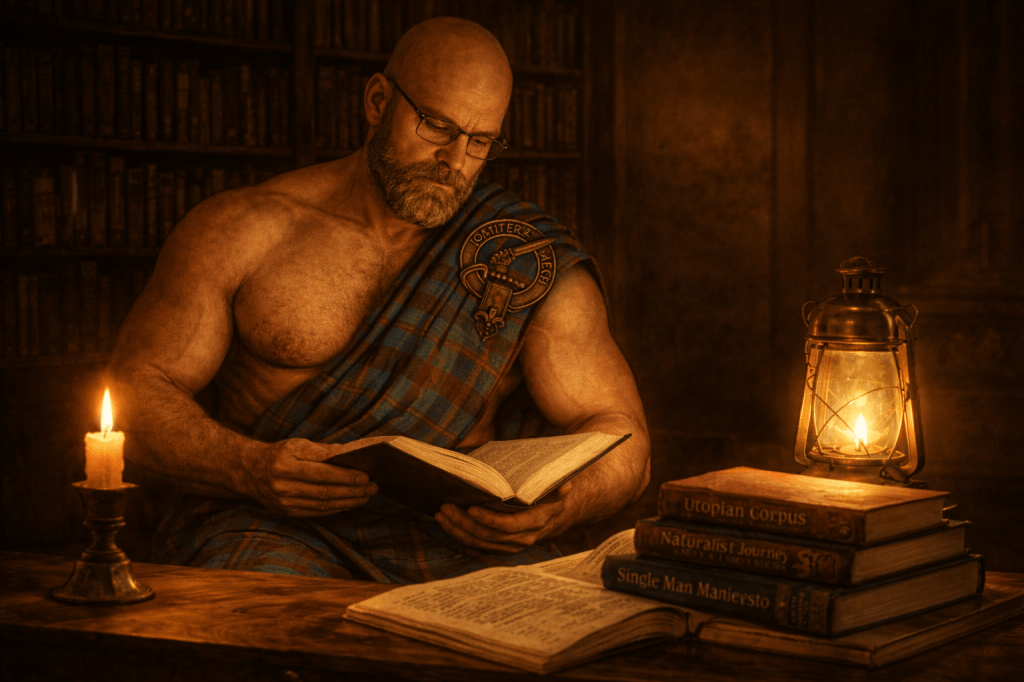
Prologue: Study, Fracture, and First Clarity
I did not leave Christianity lightly, nor did I abandon it in a moment of emotional upheaval. My departure began with something far more deliberate and far more revealing: study. Not devotional reading. Not selective affirmation. Study; the kind that demands you hold the text at arm’s length, examine its structure, trace its origins, and test its claims against the broader landscape of human history and myth.
As a child, I absorbed the stories the way all children do; trusting, sincere, and uncritical. But my faith did not survive intact into adulthood. By my late teens, the internal disconnect had already begun. The doctrines I had been taught no longer resonated with the world as I experienced it, and the God I was told to believe in grew increasingly distant from anything I could honestly claim as true. In my twenties, I drifted into a vague spiritualism, still searching for meaning but without the language or cultural grounding to understand what I was actually reaching toward. I felt unanchored; not just from religion, but from any sense of heritage or identity.
This led me to trace my paternal genealogy, and for a time I assumed my family line was Scottish. That assumption came from similarity of names and the broad cultural stereotypes linking “Celtic” identity with Scotland. But as I followed the records back with greater care, the truth emerged. My line does not lead into the Highlands; it leads into Devon, into the older Brythonic substrate that predates Anglo-Saxon influence. My ancestry is rooted not in Scottish clans but in the southwestern Celtic people known as the Dumnonii, whose land later became Devon and Cornwall.
Realizing this reshaped everything. Instead of reaching toward an imagined Scottish past, I was reconnecting to something older and more geographically grounded; a people whose worldview aligned far more closely with the instincts and philosophies I had lived by for decades without knowing their name. The values I had felt rising within me; Naturalism, reciprocity, embodied reverence, skepticism toward dogma; were not inventions of adulthood. They were the distant echoes of a heritage I had never been taught, yet somehow recognized the moment I encountered it.
What I didn’t yet realize was that I had already begun living a different worldview entirely. Long before I knew the word for it, I was practicing Naturalism. Long before I encountered the philosophies, I was adhering instinctively to the ethical orientations of Cynicism, Stoicism, and Skepticism. I trusted evidence over dogma, inquiry over certainty, and the natural world over metaphysical abstraction. My only reliable anchor was knowledge; science, reason, the tangible and observable. These were not rebellious impulses; they were the first signs that my mind was shaped for a different orientation than the one I had inherited.
When I finally returned to the Bible as an adult, I approached it not as a believer seeking reassurance but as a student seeking understanding. I carried with me the tools of inquiry; archaeology, comparative mythology, textual criticism, linguistics, anthropology; and with each page, the ground beneath the inherited narrative shifted. The faith I had walked away from in my youth did not collapse suddenly; it simply revealed itself as a story that had never truly fit the shape of my mind.
What I found was not the seamless divine revelation I had been taught to expect. Instead, I encountered layers upon layers of human fingerprints: contradictions born of competing communities, moral laws shaped by the anxieties of tribal survival, prophecies retrofitted to match political needs, and narratives whose roots extended far beyond the borders of the ancient Near East. The creation stories echoed older Babylonian myths. The flood narrative paralleled Mesopotamian epics.
The Christian figure of Satan did not arise from early Judaism; which had no independent devil figure; but from later influences, especially Zoroastrian dualism, which introduced a cosmic adversary opposed to a supreme good. As Christianity spread into Europe, this dualistic template absorbed and demonized local deities. One of the clearest examples is Cernunnos, the antlered Celtic god associated with nature, renewal, fertility, and the wild. To the peoples of Britain and Gaul, Cernunnos symbolized balance between human life and the natural world. But to incoming Christian authorities, his horns and animal associations made him an ideal target for reinterpretation. Over time, the imagery of Cernunnos; antlers, wildness, masculine vitality; was collapsed into the iconography of the Christian Satan. A life-affirming deity was recast as a symbol of evil, not because of his nature, but because Christianity needed to delegitimize the spiritual frameworks that preceded it.
Cernunnos, in particular, represents the violence of that reinterpretation. To Celtic peoples; including the Brythonic ancestors of the Dumnonii; he was not a demon but a guardian of cycles, animals, forests, and the sacred continuity of life. His antlers were symbols of regeneration, not wickedness. But Christianity, uncomfortable with a deity rooted in embodied nature and fertility, treated such imagery as threatening. The horns of Cernunnos became the horns of Satan; the forest god became the adversary. This was not an organic theological evolution. It was cultural overwriting; an attempt to sever people from their ancestral worldview by turning their gods into devils.
Even the figure of a suffering, dying, and resurrecting savior was not new in the first century; Mediterranean religions already told stories of divine or semi-divine figures who endured death and returned to life, symbolizing renewal and cosmic harmony. When I studied the historical Jesus rather than the theological one, I also discovered that several scholars have proposed that the events surrounding the crucifixion were far more human and far less supernatural than tradition suggests. Crucifixion kills through progressive asphyxiation, not blood loss. When the Roman soldier pierced Jesus’s side, the wound may have relieved the pericardial effusion or pleural fluid that builds under extreme physiological stress; in modern medical terms, this resembles cardiac tamponade, a condition where fluid around the heart restricts breathing. The lance thrust, rather than proving death, may have allowed him to breathe again. According to these theories, his rapid removal from the cross, the involvement of wealthy sympathizers, and the payment of family supporters created the conditions for survival rather than resurrection. In this scientific evaluation, Jesus does not rise from the dead; he escapes a botched execution and later leaves the region with Mary Magdalene, who may have been his partner or wife. Whether or not one accepts these hypotheses, the point remains clear: the traditional resurrection narrative is neither unique nor historically inevitable. It is one interpretation layered over a complex human event.
None of this diminished the literary or cultural value of the biblical text, but it shredded the illusion that Christianity stood apart from the mythic currents of the ancient world. Once the text was stripped of its aura and examined as a human document, the theological scaffolding I had inherited; original sin, substitutionary atonement, divine moral authority; no longer seemed inevitable or even coherent. I began to see how deeply Christianity depended on the meanings it borrowed, reshaped, or overwrote.
This realization cracked something open inside me. Not my sense of self; the illusion of what my self had supposedly been built upon. For years, I had tried to force my worldview into the shape Christianity demanded: obedience over curiosity, sin; consciousness over embodied life, separation from nature rather than immersion in it. Yet the moment I recognized that Christianity was not a singular divine truth but one mythology among many, something in me exhaled for the first time.
The fracture I felt was not the breaking of faith. It was the breaking of pretense; an invitation to step beyond the imposed narrative and rediscover the worldview that had quietly shaped my instincts all along.
Why I Can No Longer Live the Lie
There is a difference between disagreement and dissonance. Disagreement can be negotiated; dissonance is a signal that something fundamental has been misaligned for a very long time. What grew inside me over the years was not mere dissatisfaction with doctrine; it was the steady recognition that the worldview Christianity asked me to inhabit was not my worldview at all.
Christianity instructed me to distrust my senses, to subordinate my reasoning to revelation, and to orient my moral life around laws born from cultures wholly unrelated to my own lineage. It demanded assent to doctrines I found ethically incompatible; eternal punishment, inherited guilt, divinely sanctioned hierarchy. And for too long, I responded the way many sincere people do: I attempted reinterpretation. I softened the edges. I translated metaphors into symbols, symbols into psychology, and commandments into guidelines.
But reinterpretation is not transformation. It is the art of trying to make a structure livable without acknowledging that its foundation does not belong to you.
Eventually, I had to confront the truth: to continue calling myself Christian would mean living a lie; not maliciously, but fundamentally. It would mean participating in a generational narrative that never fit the shape of my mind, my ethics, or my heritage. It would mean surrendering integrity for familiarity.
This is not rebellion. It is not a rejection of my upbringing or a judgment upon those who remain within the faith. It is simply the choice to stop inhabiting a worldview that contradicts everything I know about history, about science, about ethics, and about myself. Honesty requires that I step out of the inherited story and step into the one that actually reflects who I am and who I have always been.
To reclaim my identity, I must stop pretending that Christianity is its rightful home.
Christianity as Mythology Among Mythologies
To understand Christianity as mythology is not to mock it or reduce it. It is to situate it accurately within the broader tapestry of human storytelling. Every culture has sought to explain existence, morality, suffering, and the cosmos. Christianity is one such attempt; neither uniquely false nor uniquely true, but uniquely successful in its historical expansion. And when approached academically rather than devotionally, its mythic structure becomes unmistakable.
The creation story mirrors older cosmologies. The concept of the immortal soul reflects Hellenistic philosophy more than early Judaism. The dualistic struggle between God and Satan resembles Zoroastrianism. The moral codes map onto the survival strategies of ancient societies. Even its holidays align with pre-existing solstice and equinox festivals, repurposed rather than revealed.
Christianity’s power did not come from the originality of its ideas but from the authority of the empires that adopted it. The canon of the New Testament was not handed down intact from heaven; it was shaped over centuries by councils operating under imperial authority. After Constantine fused Christianity with imperial power and bound the Church to the Roman state, a series of councils determined which books would be considered scripture and which would be suppressed. Nicaea established the political framework, Laodicea began listing acceptable texts, and the Councils of Hippo and Carthage finally produced the twenty-seven-book canon recognized today. Throughout this process, bishops and emperors debated which writings supported the Church’s authority and which challenged it; texts that empowered women, emphasized personal spirituality, or presented alternative understandings of Jesus were removed.
Many writings beloved by early Christian communities were excluded, including the Gospel of Thomas, the Gospel of Mary, the Gospel of Peter, the Acts of Paul and Thecla, the Shepherd of Hermas, and other texts that portrayed Jesus, Mary Magdalene, or early Christian life in ways that did not support the developing hierarchy. The canon did not emerge organically from divine revelation; it was curated by men negotiating theology, politics, and imperial power. Its doctrines solidified through political necessity. Its spread across Europe occurred not because it offered a superior mythology, but because it absorbed, silenced, or annihilated the mythologies that preceded it.
Mythologies are not the problem. Humans need stories. We build civilizations atop them. But a mythology becomes dangerous when it declares itself the only truth, when it insists that all other stories are inferior or satanic, when it elevates metaphor to cosmic fact.
Once I recognized Christianity as a mythology rather than the mythology, its authority collapsed. I no longer felt compelled to force my identity into its framework, nor to treat it as the lens through which all meaning must pass. Instead, I could finally turn toward the worldview that aligns with my instincts, my ethics, and my ancestry; the worldview that regards the natural world not as a fallen staging ground, but as the primordial source of meaning itself.
The Catalogue of Christian Atrocities and Cultural Erasure
Christianity’s spread across Europe and beyond is often portrayed as a peaceful triumph of truth, a spiritual enlightenment that replaced superstition with divine order. But the historical record tells a starkly different story; one not of illumination, but of suppression, violence, coercion, and deliberate cultural erasure. To understand why Christianity cannot serve as the foundation of my identity, I must confront this history plainly, without sanitizing it for comfort. This is not hostility. It is honesty. If Christianity is to be examined as a cultural force, then its legacy must be acknowledged in full, not in the selective fragments that flatter it.
The first waves of Christian expansion involved the destruction of indigenous European religions. Sacred groves; places of worship for thousands of years; were cut down by bishops and kings acting in the name of Christ. Shrines were desecrated or repurposed into churches. Entire cosmologies were labeled demonic, not because of any genuine theological threat, but because their existence challenged the universality Christianity demanded. Missionaries burned idols, outlawed festivals, and criminalized ritual practices that had anchored communities to their land and ancestors. In regions such as Saxony, refusal to convert was punishable by death. The Massacre of Verden under Charlemagne, where thousands of pagan Saxons were executed for resisting baptism, remains one of the clearest examples of conversion by the sword.
The violence did not end with Europe. As Christianity entwined itself with empire, it became the theological justification for colonial expansion. Indigenous peoples across the Americas, Africa, and Oceania were met not with dialogue but with conquest. Lands were seized “in the name of Christ.” Sacred texts, languages, and oral traditions were destroyed. Children were taken from their families and placed in residential schools designed to “kill the Indian, save the man.” Missionaries imposed sexual shame on cultures whose views of the body had been harmonious for millennia. Entire populations were forced into new moral frameworks that alienated them from their ancestors and themselves.
The Crusades layered another chapter onto this history; an era of brutality in which armies marched under the cross to conquer, pillage, and massacre. Entire cities were slaughtered in the name of divine mandate. Jewish communities were annihilated in pogroms that accompanied nearly every major crusading campaign. Christian armies sacked not only Muslim strongholds but Eastern Christian cities as well, revealing that power, not faith, drove much of the violence. Even the Inquisition, often portrayed as a targeted effort to preserve orthodoxy, became a machinery of terror: torture, forced confessions, executions, and the systematic destruction of dissent.
The witch hunts of Europe further demonstrate Christianity’s role in shaping violence. Tens of thousands, mostly women, were tortured and executed on charges rooted in superstition and fear. These hunts were not random outbreaks of hysteria but institutionalized campaigns justified by biblical interpretations and church authority. Women’s bodies, knowledge, and autonomy were demonized, reinforcing patriarchal structures that still echo today.
Even when Christianity did not wield the sword directly, it wielded the tools of erasure. The church systematically replaced indigenous holy days with Christian ones, overwrote local deities with saints, and reframed natural cycles through its theological lens. In Britain, Ireland, Gaul, Iberia, and Central Europe, ancestral beliefs were not simply forgotten; they were deliberately overwritten. The body itself, once seen as a vessel of life and continuity, became a source of shame. Sexuality, previously understood as a natural and sacred aspect of existence, became bound to guilt, control, and moral scrutiny.
This legacy matters because my ancestors lived within the cultures that suffered these transformations. Their worldview; their understanding of nature, the body, community, and the sacred; was not gently integrated into Christianity. It was uprooted. When Christianity came, it brought not illumination but amnesia. And the cost of that amnesia has echoed across generations right down to me.
Acknowledging this history is not about condemnation. It is about clarity. If I am to understand who I am and where I come from, I must be willing to confront the forces that severed me from the worldview my ancestors once lived with coherence and dignity.
My Ancestral Heritage: The Brythonic Worldview of the Dumnonii
Long before Christianity shaped the Western world, my ancestors lived according to a worldview that was intimately tied to the land, the seasons, and the rhythms of nature. The Dumnonii, the Brythonic Celtic people of Devon, were not pagans in the caricatured sense that Christian chroniclers later imposed upon them. They were part of an ancient cultural fabric that understood life as an interwoven whole, where the sacred was not a distant abstraction but a presence embedded in the world itself.
The Dumnonii lived close to the earth. Their villages were structured around kinship, reciprocity, and shared labor. Their rituals honored wells, groves, stones, and landscape features that held ancestral memory. The boundaries between the physical and spiritual were porous; not in the sense of believing in supernatural hierarchy, but in recognizing that life, death, fertility, and renewal were continuous expressions of the natural world.
They did not separate morality from context. Ethical life arose from relationships: with family, with tribe, with land. Conflict required restoration, not condemnation. Wrongdoing was understood not as sin against a divine lawgiver but as a disruption in the web of reciprocity that bound people together. Leadership was earned through reputation, wisdom, and contribution; not imposed from above by divine decree.
Central to their worldview was a reverence for the body. Nudity was neither taboo nor shameful; it was natural. The body symbolized continuity; life begetting life, generation flowing into generation. Sexuality was not framed as fallen or dangerous but as a vital, life-affirming force that connected individuals to the cycles of existence. Without Christian morality defining the body as shameful or sinful, the Dumnonii embraced an ethic of embodied reverence.
Their spirituality was not dogmatic. There were no doctrines demanding assent, no texts claiming infallibility, no institutions asserting divine authority. Their reverence for natural forces; rivers, storms, forests, hills; was not worship in the modern sense but an acknowledgment of interdependence. They understood themselves as part of the world, not above it.
When Christianity arrived, this worldview was not incorporated; it was displaced. The Dumnonii’s sacred sites were repurposed as churches. Their festivals were renamed. Their deities were demonized or recast as saints. Their open, embodied understanding of life and sexuality was suppressed under Christian morality. Over time, their way of seeing the world faded into silence.
And yet, elements of their worldview survived in me; not through conscious teaching, but through intuition. My rejection of imposed shame, my reverence for nature, my belief in embodied integrity, and my instinctual Naturalism are not new inventions. They are echoes. Through rediscovering the Dumnonii, I discovered myself.
Naturalism: The Worldview I Always Held Without Knowing
Long before I ever heard the term “Naturalism,” I lived its principles intuitively. I trusted my senses. I sought evidence. I believed that meaning arose from relationships, consequences, and lived experience rather than distant, abstract commandments. I felt the sacred not in doctrine but in the immediacy of the natural world: sunlight on my skin, the flow of water, the cycle of seasons, the unspoken logic of life and decay.
Only later, through study and reflection, did I recognize that this orientation was not a personal quirk but a coherent philosophical stance; one shared by my ancestors and by countless thinkers throughout history. Naturalism asserts that reality is continuous with nature; that human beings are not fallen creatures but evolved participants in the vast ecology of existence; that morality arises from the impact of our actions, not from decrees etched in ancient texts.
Naturalism aligns seamlessly with the values that have shaped my adult life: autonomy, reciprocity, integrity, and truthfulness. It aligns with the Cynic’s insistence on authenticity, the Stoic’s discipline of inner freedom, and the Skeptic’s commitment to evidence and inquiry. These ethical orientations are not hostile to spirituality; they are pathways toward a grounded, embodied understanding of meaning.
Naturalism also restores what Christianity took: reverence for the body. Under this worldview, the body is not a vessel of sin but a vessel of life, continuity, and experience. Sexuality is not a temptation but an expression of vitality. Nudity is not shameful but natural. The earth is not a temporary testing ground but a source of belonging.
When I look back on my life; from childhood instincts to adult convictions; I see that Naturalism was always there, quietly guiding me toward a worldview that Christianity could not contain. It was not rebellion. It was recognition. It was memory resurfacing.
Naturalism is not something I adopted. It is something I uncovered. It is the worldview that fits the shape of my mind, the ethics of my life, and the heritage of my people.
Embodied Reverence: The Body, Sexuality, and the Pre-Christian Ethos
In the worldview of my ancestors, the body was not a battleground between purity and sin. It was not a source of shame, nor an object requiring concealment, suppression, or moral suspicion. The Dumnonii and other Brythonic Celtic peoples lived within an embodied ethos in which the physical self; its instincts, its vulnerabilities, its desires, its cycles; was understood as a natural expression of life itself. They saw the body as an inheritance, not a liability; a vessel of continuity, not corruption. In this worldview, nudity did not carry erotic charge by default, nor did it signify moral danger. It was simply the body unadorned, the human form in its honest state, worthy of neither ridicule nor restraint.
This orientation toward embodiment is not an abstract fantasy of an imagined past. Archaeological evidence, artistic depictions, ritual practices, and Roman commentary all point toward a people who saw no conflict between the body and the sacred. Warriors sometimes fought unclothed not out of spectacle, but symbolism; an assertion of courage, vulnerability, and unity with the natural world. Seasonal festivals incorporated communal bathing, ritual cleansing, and celebrations of fertility that linked the human life-cycle to the cycles of the land. Sexual expression was not hidden behind veils of guilt; it was integrated into a holistic understanding of vitality. Consent, reciprocity, and communal well; being mattered far more than Christian notions of purity.
What Christianity later condemned as “pagan immorality” was, in truth, an ethic of embodied reverence: a worldview that saw sexuality not as sin to be controlled, but as creative force to be respected. The sharp division between body and spirit; central to Christian theology; simply did not exist in my ancestral culture. There was no expectation that one should distrust one’s physical self or view desire as inherently dangerous. The body was not seen as a temptation leading away from God, but as an inseparable part of a person’s identity, a bearer of dignity in its own right.
When Christianity swept across Celtic lands, it sought not merely to convert beliefs but to transform the relationship people had with their own bodies. Nudity became shameful. Sexuality became a site of moral panic. The Christian obsession with purity; especially female purity; stood in stark opposition to the embodied freedom that characterized pre-Christian life. Monastic scribes rewrote old stories, turning goddesses of sovereignty into saints or demons, suppressing traditions that honored fertility, passion, or the sacred feminine. Over time, the natural human form became associated with danger, temptation, and weakness. A worldview that had once affirmed life in all its physical realities was replaced by one that viewed the flesh as something fallen.
My own journey toward Naturalism has included a rediscovery of this ancestral attitude toward the body. I grew up in a culture shaped by Christian moral frameworks; frameworks that taught me to distrust my physicality, to feel self-conscious in my own skin, and to assume that desire carried moral weight by default. But as I stepped outside that worldview, I began to notice how much of my discomfort had been inherited rather than chosen. The moments in my life when I felt most whole, most free, most aligned with myself were moments when I rejected imposed shame and embraced a Naturalistic understanding of embodiment. This shift felt less like a new belief and more like the resurfacing of something I had always known.
To honor my ancestry is to reclaim that embodied reverence; to refuse the narrative that my body is inherently flawed or morally suspect, to affirm sexuality as a natural dimension of human life, and to recognize that shame is not a virtue. It is a cultural artifact. My ancestors did not fear their bodies. Neither do I.
My Ethical Framework:
Cynicism, Stoicism, and Skepticism
As my worldview moved further from Christianity and closer to Naturalism, I discovered that the ethical frameworks that resonated most deeply with me belonged not to religious doctrine but to philosophical traditions grounded in experience, critical thought, and lived integrity. Cynicism, Stoicism, and Skepticism; each in their own way; offered tools for navigating life that aligned with both my temperament and my ancestral inheritance. These were not mere intellectual curiosities; they were philosophies that echoed the pragmatic wisdom of pre-Christian cultures while offering modern language for principles I had long practiced without knowing their names.
Cynicism, in its classical form, is often misunderstood. It is not negativity, bitterness, or distrust. It is the commitment to live authentically, free from pretense, social corruption, and unnecessary convention. The Cynics taught that a good life requires honesty about one’s nature, simplicity in one’s needs, and the courage to reject systems that distort human flourishing. In many ways, Cynicism articulates what my ancestors lived instinctively: an existence rooted in what is real rather than what is imposed. It affirms my refusal to live a lie, my desire to align my life with truth rather than expectation.
Stoicism complements this by offering a framework for emotional resilience, ethical clarity, and inner freedom. The Stoics recognized that suffering often arises from trying to control what lies outside our power. Their remedy was not resignation, but disciplined engagement with reality. They urged individuals to cultivate virtue through wisdom, courage, justice, and temperance; qualities that mirror the communal ethics of the Dumnonii. Stoicism does not demand obedience to divine authority; it asks for alignment between one’s actions and one’s values. It offers a way to meet life’s difficulties with steadiness rather than fear.
Skepticism, finally, provides the intellectual grounding for my Naturalism. It is not the rejection of belief, but the refusal to accept claims without sufficient evidence. It is the discipline of inquiry, the willingness to say “I do not know” rather than cling to comforting certainties. Skepticism frees the mind from dogma; religious or otherwise; and opens the door to genuine understanding. In practice, it is the philosophical antidote to unquestioned authority, echoing my desire to examine Christianity critically rather than accept it out of tradition.
Together, these ethical frameworks form the core of how I navigate the world. They allow me to live truthfully, respond to reality with clarity, and remain intellectually honest. They align with the Naturalistic worldview that feels not only authentic to me but consistent with my ancestral heritage. In many ways, these philosophies articulate the values my ancestors lived, even if they did not name them: authenticity, resilience, inquiry, reciprocity, and embodied integrity.
This is the ethical foundation I choose; not one imposed by fear of punishment or promise of reward, but one grounded in wisdom, experience, and the desire to live as a whole human being.
Why Christianity Cannot Be My Identity
By the time I reached adulthood, I had already moved beyond Christianity without fully understanding why. I thought my discomfort with the faith was personal; something idiosyncratic, perhaps even a failing on my part. Only later, when I studied its history, examined its doctrines, and rediscovered my ancestral worldview, did I realize that my discomfort was not a personal defect. It was a sign of misalignment. Christianity asked me to inhabit a worldview that contradicted my ethics, denied my heritage, and conflicted with the Naturalistic orientation that had shaped my thinking since childhood.
I cannot embrace a religion that views the natural world as fallen when my entire being resonates with its beauty, continuity, and truth. I cannot identify with a tradition that treats the body as a vessel of sin when my ancestors; and my own experience; teach me that the body is sacred in its own right. I cannot accept doctrines built on fear, guilt, and hierarchy when my ethical frameworks call me toward honesty, resilience, and inquiry.
Christianity is not the story of my people. It is not the home of my worldview. The farther I step from it, the clearer this becomes. My identity is rooted in a different soil; one cultivated by the Dumnonii, shaped by Naturalism, and refined through philosophical inquiry. To continue calling myself Christian would be to betray that inheritance, to deny what I know to be true about myself and the world.
And so I choose clarity over comfort, integrity over expectation, truth over tradition.
A Homecoming: Not Rebellion, but Return
To reject Christianity is often framed; by those who remain inside it; as an act of rebellion, a departure from the values one was raised with, or a rejection of family and tradition. But nothing in my journey resembles rebellion. What I have undertaken is not a break, but a return; not a severing, but a homecoming. For decades I tried to inhabit a worldview that never fit the shape of my mind or the contours of my ancestry. I pressed myself into forms that were foreign to me, convinced that obedience was virtue and conformity was peace. But the more I studied, the more I reflected, and the more I listened to the quiet truths within myself, the clearer it became: I was not leaving something. I was returning to something older, deeper, and unmistakably mine.
This return is not a romanticization of the past, nor an attempt to reconstruct ancient rituals for their own sake. What I am reclaiming is not a pantheon, but a worldview. The framework that has emerged in my adult life; the Naturalism I live by, the ethic of reciprocity I practice, and even the philosophical architecture of the Utopian Society that I have been building; all echo the values my ancestors lived without ever needing scripture or dogma. What I am restoring is not superstition, but coherence; not mythology, but orientation. I am reclaiming a way of seeing the world that aligns with nature, community, embodiment, and integrity. The Utopian Society is not a reenactment of Dumnonii life, but a modern expression of the same principles that shaped them: balance, stewardship, accountability, and the freedom to live without shame. It reclaims a way of living grounded in reciprocity rather than hierarchy, meaning rather than profit, and community rather than the subjugation demanded by capitalism.
It is a recognition that my intuition, my philosophy, and my values were never truly Christian; they were naturalistic, ancestral, rooted in continuity rather than rupture. Christianity taught me to think of myself as separate from the world, as a fallen being in need of salvation. But everything in my lived experience told me the opposite: that I belonged to the world, not above it or apart from it; that my morality arose not from commandments, but from empathy, reciprocity, and consequence; that my worth was not contingent upon belief.
As I rediscovered my ancestral roots, everything that had once seemed dissonant in Christianity found its explanation. The Dumnonii worldview; grounded in nature, community, embodiment, and cyclical understanding; mirrored the instincts I had spent most of my life trying to suppress. Naturalism did not pull me away from anything real. It pulled me away from illusion, from the pressure to adopt a cosmology that contradicted my own perceptions. Christianity asks its followers to mistrust their senses; my ancestors trusted theirs. Christianity centers shame around the body; my ancestors honored it. Christianity separates the sacred from the world; my ancestors saw the sacred in the world.
This homecoming is not an indictment of my upbringing. My parents gave me the framework they had inherited; they offered the tools available to them. But inheritance is not identity. Tradition is not destiny. Every person reaches a point where they must discern which parts of their inheritance align with truth;and which must be set down for the sake of integrity. My return to an older worldview is not a rejection of my family. It is an affirmation of myself.
Nor is this homecoming a rejection of meaning. On the contrary, it is the first time meaning has felt grounded, coherent, and honest. I no longer have to force myself into beliefs that deny the evidence of the world or the instincts of my own mind. I no longer have to pretend that morality is something granted from above rather than cultivated from within. I no longer have to live as though my body is an obstacle rather than an inheritance.
Coming home means acknowledging that the worldview that resonates with me; the one that affirms nature, ancestry, embodiment, and inquiry; has always been present beneath the surface of my life. It was obscured, not erased. Christianity was the overlay. Naturalism is the foundation.
Stepping away from Christianity has not diminished me. It has clarified me. It has allowed me to step into myself without hesitation or apology. It has given me coherence where there was once dissonance, integrity where there was once pretense, and a sense of belonging that Christianity never offered.
This is not rebellion. This is return.
Name, Identity, and Continuity
Names are not merely labels. They are cultural containers, carrying expectation, inheritance, and worldview. The name I was given at birth remains my legal identity, and I do not reject it lightly. It reflects a Christian lineage and cultural framework that shaped my early life and education. I honor that history for what it gave me. But it no longer describes who I am.
As my understanding of my ancestry, worldview, and ethical orientation clarified, it became increasingly apparent that my given name functioned as a remnant of a narrative I no longer inhabit. Retaining it as my sole identifier felt less like continuity and more like misrepresentation.
I have therefore chosen a Celtic name drawn from the Brythonic tradition of my ancestors, reconstructed from Proto-Celtic roots rather than taken from any modern living language. Its meaning is both etymological and interpretive. Adreto Nagdo Senoviros (/əˈdrɛ.toʊ ˈnaɡ.doʊ sɛˈnɔ.vɪ.roʊs/). Its meaning reflects values central to my life—“the returned one, naked and unarmored, the wise man of great vitality”; “he who has come back to himself, bare and truth-filled, alive in strength”; “the rediscovered, unclothed, wise and vigorous man.” I have mirrored the traditional naming convention of first, middle, and surname. Interestingly, the surname is a conjunction of two Celtic words. This name is not an affectation or a rejection of modern life. It is an act of alignment—an acknowledgment that identity is not only inherited, but also chosen through understanding. It reflects discovery through research and knowledge, my reclamation of a lost heritage, a nod to my Naturalism through double entendre, and an honest acknowledgment of my sexuality as an integral part of my nature.
For legal and practical purposes, I continue to use my given Christian name—and, admittedly, because my wife begged me not to change it legally. But in personal, philosophical, and cultural contexts, the Celtic name better reflects the individual I have become. This dual usage is not confusion; it is honesty. One name satisfies institutions. The other satisfies integrity.
Closing Declaration: I Will Not Live the Lie
This is the point where clarity becomes commitment. Where understanding becomes articulation. Where the internal alignment I have cultivated demands expression in plain, unambiguous language. I have spent decades navigating the quiet tension between the worldview I inherited and the worldview that emerged through study, reflection, and self-honesty.
Christianity is not my story. It is not the inheritance that speaks to my blood, my instincts, or my ethics. It does not reflect the world as I experience it, nor the truths I have discovered, nor the values that shape my life. Its doctrines do not align with my understanding of reality. Its moral frameworks do not align with my understanding of justice. Its worldview does not align with my understanding of existence.
I do not reject Christianity to wound or distance myself from those who hold it dear. I honor the sincerity with which others believe, and I respect the place it holds in their lives. But respect cannot require self-betrayal. Understanding cannot require silence. Love cannot require the surrender of identity.
What I have reclaimed; my Naturalism, my ancestral worldview, my embodied sense of meaning; is not a substitute for Christianity. It is the worldview that fits the shape of my mind, the weight of my history, and the truth of my life. It is a return to coherence, to continuity, to the ethical and philosophical clarity that emerges when one stops forcing oneself to believe what one does not believe.
My life is no longer guided by fear of punishment or hope of reward. It is guided by inquiry, compassion, integrity, and the recognition that meaning is created through how we live, not what we profess. My morality is rooted in consequence, empathy, and responsibility; not doctrine. My reverence is rooted in the world as it is, not as an institution claims it must be.
This closing declaration is not a severing of ties. It is a statement of selfhood. It is the articulation of an identity that has been forming for decades, now finally stepping into the light with confidence and honesty.
I am not lost. I am not rebelling. I am returning;to my ancestry, to my nature, to my integrity, and to the truth that has lived within me long before I had the words to name it.
So I say with clarity and without apology:
I will not be complicit.
I will not live the lie.
This is who I am. This is who I have always been. And this is who I will continue to be.

 Utopian Society
Leave a comment