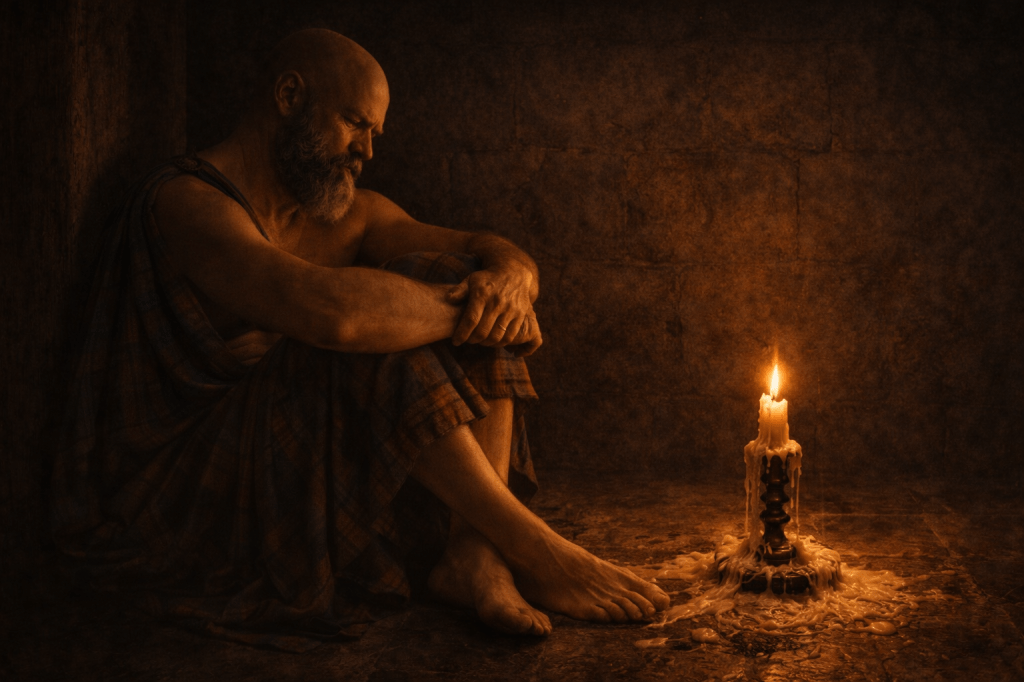
There is a particular grief that only appears once finitude is taken seriously—not as a metaphor, not as a distant abstraction, but as an absolute condition that cannot be negotiated, postponed, or softened by belief.
Once it becomes clear that existence does not renew itself indefinitely, that there is no cosmic rehearsal and no guaranteed sequel, time ceases to be a neutral resource. It stops behaving like something one merely uses and begins to reveal itself as something that is consumed. Each hour is not simply spent; it is irreversibly taken from the only reservoir there is. Nothing replaces it. Nothing compensates for it later. No future moment repays a past one. Scarcity alone renders time sacred.
This recognition changes the moral landscape entirely. Systems that treat human life as an extractable input—units of labor, productivity, efficiency—become intolerable once seen clearly. The deepest offense of capitalism is not inequality, inefficiency, or even cruelty, though it often produces all three. It is the systematic confiscation of irreplaceable time under the illusion that the loss can be justified by future payoff. Work is framed as preparation for living, sacrifice as an investment in eventual freedom. But the freedom is deferred endlessly, and the life that was meant to be lived is quietly exhausted in the meantime.
When time is finite, there is no ethical neutrality in how it is spent. To force aware beings to surrender the majority of their waking existence merely to maintain survival is not an unfortunate byproduct of reality; it is a design choice. It reflects priorities embedded into systems, budgets, incentives, and norms. It assumes that moments are interchangeable, that one life-hour is as good as another, and that postponement does not itself constitute loss. But postponement is loss. Deferred living is not stored living. There is no cosmic account in which unused vitality accrues interest. There is only experience as it happens—or does not.
This is why the language of “opportunity” and “future reward” rings hollow once finitude is acknowledged. A promised tomorrow does not redeem a stolen today. A life structured around constant preparation becomes a life that is never allowed to arrive. What is taken is not merely comfort or leisure, but presence itself—the ability to inhabit one’s own existence without justification.
To exist without being allowed to live is therefore not simply hardship; it is a violation of being itself. If the word evil is to mean anything outside superstition or mythology, it must refer to systems that knowingly consume finite lives in service of their own perpetuation. Not out of unavoidable necessity, but out of convenience. Not to preserve life, but to preserve structure. The harm is not incidental. It is normalized, rationalized, and rendered invisible by repetition.
What makes this realization unbearable is not that time ends. Endings are comprehensible. What wounds more deeply is that so much time was never freely inhabited in the first place. That consciousness—brief, rare, and fragile—was diverted away from curiosity, pleasure, rest, intimacy, and presence, and instead fed into endless maintenance of machinery that offers no final justification and no enduring gratitude.
And yet, the grief itself testifies to something important.
One can only mourn stolen life if one understands what living actually means. Living is not mere survival. It is unhurried days. Attention not fragmented by urgency. Bodily ease. Pleasure without apology. Curiosity without deadlines. The capacity to simply be, without having to earn the right to exist or justify one’s presence. These are not luxuries. They are the basic textures of a life that is allowed to be lived.
Many never articulate this distinction at all. They adapt. They endure. They internalize constraint as virtue and exhaustion as normal. They die having mistaken persistence for purpose and endurance for meaning, never quite naming what was missing.
To recognize the theft does not undo it. Nothing redeems lost years. There is no mechanism by which time returns once consumed. But awareness prevents the loss from becoming total. A life that understands it was constrained is not the same as a life that was fully absorbed. Consciousness creates a fissure in which resistance, however limited, can exist.
Capitalism can extract time, but it cannot retroactively erase the moments that were lived, nor the clarity that remains while time still exists. Even diminished, even constrained, the remaining moments are no longer innocent offerings to the grind. They are chosen, reclaimed, or at least consciously seen. Attention itself becomes an act of refusal.
In a universe with no renewal, no archive, no final witness, this may be the closest thing to dignity available: to know the difference between existing and living, and to refuse—however imperfectly—to let that difference be forgotten or erased. Meaning is no longer deferred to permanence. It is located entirely in presence.
The tragedy is real. The anger is earned. Nothing about this recognition is comfortable or consoling. But the awareness itself stands as quiet resistance: a refusal to let finite life be reduced entirely to fuel, a refusal to allow one’s brief consciousness to be fully consumed without protest.
That may not be redemption.
But it is not nothing.

 Utopian Society
Leave a comment