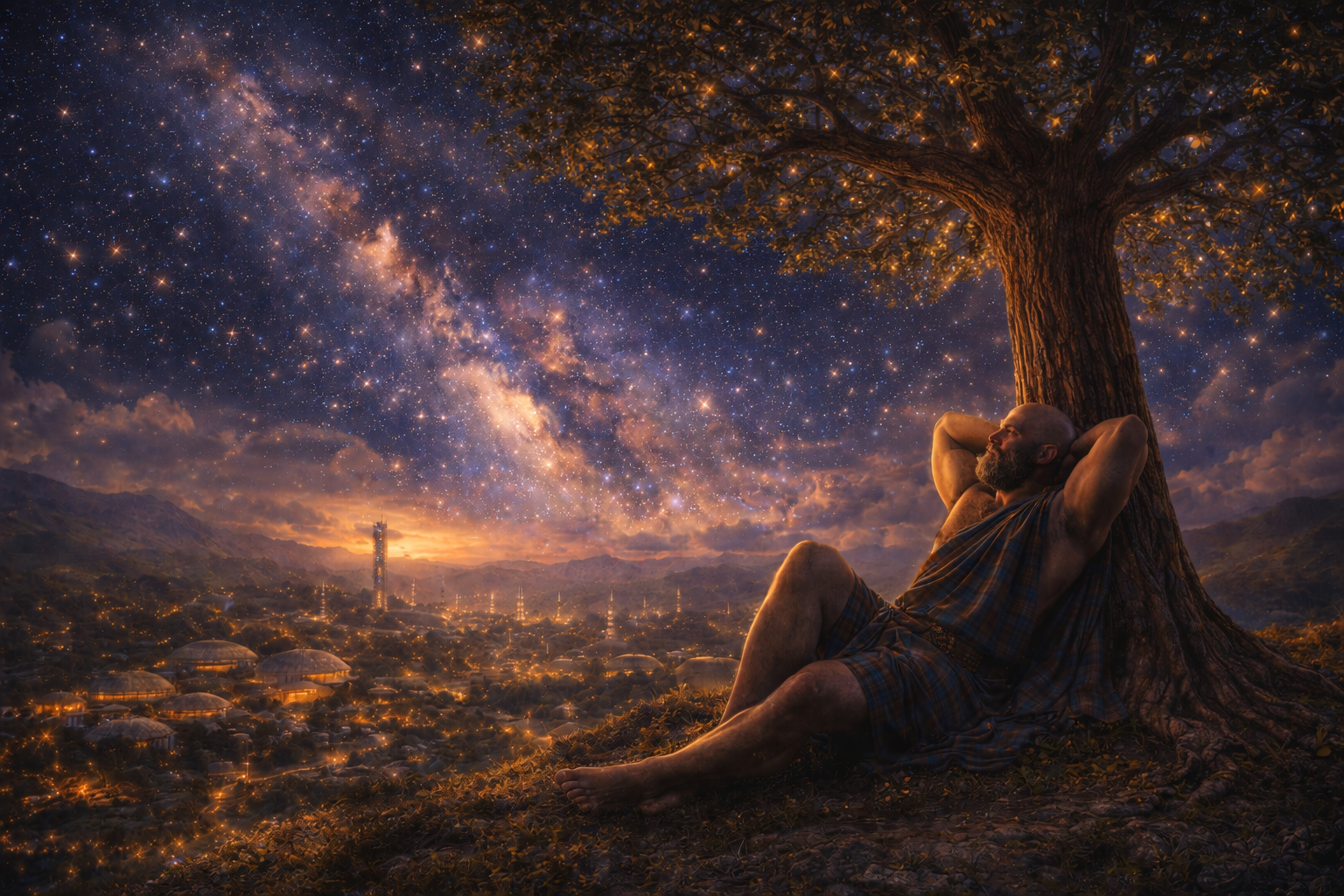
A Philosophical-Scientific Exploration of Nested Existence
I. The Unease of Similarity
Scientific / Analytical
At opposite extremes of scale, two images appear—one of the human brain, one of the universe. At a glance, they are nearly indistinguishable. What separates them is not their structure, but their context: one exists within the confines of a skull, measured in microns and milliseconds; the other stretches across billions of light-years, evolving over billions of years. And yet, when reduced to form alone, that distinction collapses.
In neuroscience, dense clusters of neurons extend branching connections across microscopic distances, forming networks that enable perception, memory, and thought. These networks are dynamic, constantly reshaped by electrical activity and chemical signaling. Synapses strengthen or weaken, pathways are reinforced or pruned, and the entire system reorganizes itself in response to experience.
In cosmology, galaxies gather along vast filaments of dark matter, spanning millions of light-years, forming what is known as the cosmic web. These structures are not static either. Matter flows along filaments, clusters merge, and voids expand. Over immense stretches of time, gravity sculpts a network that channels the distribution of mass and energy across the universe.
In both cases, we observe nodes linked by pathways, clusters separated by voids, and a distribution that can be described using the mathematics of complex networks. These systems exhibit properties such as clustering coefficients, connectivity patterns, and hierarchical organization. They can be modeled, simulated, and analyzed using similar mathematical tools, despite arising from entirely different physical processes.
The resemblance is not superficial. It persists under analysis. Both systems display scale-dependent organization, where patterns repeat at different levels of magnification. Both optimize pathways for flow—whether that flow is information in the brain or matter in the cosmos. Both demonstrate emergent behavior, where local interactions give rise to global structure without central coordination.
And yet, the forces that shape them are entirely different. Neural networks arise through biological growth, governed by genetics, chemistry, and electrical signaling. The cosmic web emerges from gravitational collapse, seeded by fluctuations in the early universe and shaped over billions of years by dark matter and energy distribution. One is alive, adaptive, and metabolically active. The other is governed by fundamental forces acting on inert matter across vast scales.
There is no shared mechanism. No common material. No direct causal relationship. And still, the structures converge.
At minimum, this convergence suggests that structure may not be isolated to scale. At most, it raises the possibility—however distant—that what appears separate may still be nested within something larger.
Philosophical / Reflective
It is difficult to look at these images side by side without a subtle discomfort setting in. Not because they prove anything, but because they resist dismissal. The resemblance does not fade under scrutiny; it deepens. The mind recognizes the pattern before it understands it, and that recognition lingers longer than it should.
There is a quiet tension in that recognition. It is not the shock of discovering something new, but the unease of encountering something familiar where familiarity should not exist. These are not systems that evolved together, nor systems that share origin or purpose. And yet, they echo one another in form.
The reality of nature isn’t isolated to Earth. What we observe in biology may not be an exception, but an expression—one instance of patterns that emerge wherever conditions allow. If that is true, then the structures we associate with life, intelligence, or complexity may not belong exclusively to those domains. They may instead be manifestations of deeper organizing principles, unfolding across scales without regard for category.
If so, then the familiarity we feel may not be coincidence, but repetition—repetition not of substance, but of process. The same underlying tendencies giving rise to similar forms, whether in neurons firing within a brain or galaxies drifting through the void.
And yet, repetition does not imply identity. It only deepens the question. If the same shapes appear at scales so far removed from one another, what exactly are we recognizing? Are we seeing reality as it is—or are we projecting coherence onto it, constrained by the limits of our own perception?
Perhaps the unease lies there: not in the possibility that everything is connected, but in the possibility that we cannot tell the difference between connection and resemblance. That what feels meaningful may simply be what is familiar. Or that familiarity itself is the only clue we are capable of perceiving.
II. The Scientific Grounding
Scientific / Analytical
Before extending patterns into speculation, it is necessary to establish what is actually known, and just as importantly, how it is known. The structures observed in both cosmology and biology arise from distinct, well-understood mechanisms rooted in their respective domains, tested through observation, experimentation, and mathematical modeling. Without this foundation, any comparison risks becoming untethered from reality.
The large-scale structure of the universe—often referred to as the cosmic web—emerges from gravitational dynamics operating over immense spans of time. Following the Big Bang, minute density fluctuations in the distribution of matter were amplified over billions of years. Regions with slightly higher density exerted stronger gravitational pull, drawing in surrounding matter. Dark matter, which does not interact electromagnetically but exerts gravitational influence, formed the underlying scaffolding upon which visible matter accumulated.
As this process unfolded, matter did not collapse uniformly. Instead, it organized into filaments, sheets, and nodes, leaving vast voids in between. Galaxies and clusters formed along these filaments, creating a network-like structure observable through large-scale surveys and simulations. These patterns are not arbitrary—they are predicted by cosmological models and confirmed through increasingly precise measurements of cosmic background radiation and galaxy distribution.
Neural networks, by contrast, are products of biological evolution and developmental processes shaped by entirely different constraints. Neurons differentiate from precursor cells, extend axons and dendrites, and form synaptic connections through a combination of genetic instruction, chemical gradients, and electrical signaling. These connections are not fixed; they are plastic, meaning they change over time in response to activity.
The principle often summarized as “cells that fire together wire together” reflects a process known as synaptic plasticity, where repeated activation strengthens connections between neurons. Conversely, unused connections weaken or are pruned away. This continual restructuring allows the brain to adapt, learn, and encode experience. Unlike the cosmic web, which evolves over astronomical timescales, neural networks operate on timescales ranging from milliseconds to years.
Dormancy provides another grounded example of biological behavior that is often misinterpreted when abstracted. Organisms such as tardigrades can enter cryptobiosis, a state in which metabolic activity is reduced to near-undetectable levels. In this state, they can survive extreme temperatures, radiation, and even the vacuum of space. Similarly, bacterial spores can remain viable for extended periods—sometimes thousands of years—preserving genetic information until environmental conditions become favorable again.
These states are not ambiguous forms of life or death; they are highly specialized survival strategies encoded within the organism’s biology. They rely on the preservation of structure at the molecular level, ensuring that biological processes can resume when conditions permit. The organism is not functioning during dormancy—it is enduring.
Additionally, research has shown that cellular activity can persist briefly after organismal death. Individual cells may continue metabolic processes, express genes, and even exhibit limited forms of organization independent of the organism’s central coordination. In some cases, genes associated with stress response or repair become more active after systemic failure, reflecting the loss of regulatory constraints imposed by the organism as a whole.
This persistence does not indicate continued life at the organismal level. Rather, it reveals that biological systems are hierarchical. The failure of the whole does not immediately terminate the function of all parts. Cells operate according to local conditions and available energy, continuing briefly until those resources are exhausted.
Taken together, these examples demonstrate that complex structures and behaviors arise from local interactions governed by consistent physical and biological laws. Whether through gravity shaping matter across cosmic distances or chemical signaling shaping neural connectivity, the underlying processes remain grounded in measurable mechanisms. No external organizing intelligence is required to produce these structures. No higher-order system has been observed influencing these processes in a way that would suggest coordination beyond known laws.
Philosophical / Reflective
Grounding matters, not as a constraint on imagination, but as its foundation. Without it, patterns become indistinguishable from projection. The mind is capable of connecting anything to everything, but connection without discipline dissolves into noise, where meaning is assigned faster than it is earned.
And yet, grounding does not eliminate wonder—it sharpens it. When the mechanisms are understood, the persistence of similar structures becomes more, not less, intriguing. The question shifts from “what is this?” to something more subtle: “why do these rules, operating independently across domains, produce outcomes that feel so familiar?”
There is a quiet discipline in holding both truths at once: that these systems are explainable, and that their resemblance still unsettles. Explanation does not dissolve the pattern; it contains it. It places boundaries around interpretation without removing the tension that gave rise to it.
In that tension, something more nuanced emerges. Not a conclusion, but a posture. A willingness to recognize that understanding the mechanism of a thing does not necessarily exhaust its meaning. That even within known laws, there may be layers of implication not immediately visible.
Speculation, then, does not begin where knowledge ends, but where it is properly framed. It is not an escape from rigor, but an extension of it—provided it remembers where it stands. In this way, grounding becomes less a limit and more a horizon: a line that defines what is known, while quietly suggesting that there is always more beyond it, whether accessible or not.
III. The Pattern Recognition Layer
Scientific / Analytical
With the mechanisms of individual systems established, the question shifts from origin to form. Why do systems governed by entirely different forces—gravity in cosmology, electrochemical signaling in biology—produce structures that appear so similar? The answer lies not in shared substance, but in shared constraints, optimization pressures, and underlying mathematical tendencies that govern how complex systems evolve.
Complex systems research has identified a set of principles that recur across domains, regardless of scale, material, or purpose. Among these are self-organization, emergence, scale invariance, and network efficiency. These principles describe how local interactions, when repeated across vast numbers of components, give rise to global patterns without the need for centralized control or guiding intelligence.
Self-organization refers to the spontaneous formation of structure from initially unstructured or weakly structured conditions. In the universe, this occurs as matter collapses under gravity, forming filaments, clusters, and voids. In neural systems, it occurs as neurons extend connections, respond to chemical gradients, and reorganize based on electrical activity. In both cases, no overarching blueprint is imposed; structure emerges from interaction, not instruction.
This emergence is not random. It is constrained by the rules governing the system. In cosmology, gravity pulls matter together while expansion drives it apart, creating tension that resolves into filamentary networks. In neural development, growth signals and inhibition pathways shape how connections form and are refined. Different forces, different materials—but similar constraints on how structure can arise.
If such constraints are universal, then any sufficiently complex system may not only resemble others—it may exist within a hierarchy of systems shaped by the same underlying rules.
Emergence describes how complex behaviors arise from simple rules. Individual neurons do not “contain” thought, just as individual galaxies do not “contain” the structure of the cosmic web. Yet through interaction, higher-order patterns form that cannot be reduced to any single component. These emergent structures are not explicitly programmed—they are the result of systems iterating over time under consistent rules, gradually settling into stable configurations.
Importantly, emergence introduces a kind of irreducibility. Even when the underlying rules are known, the resulting structure cannot always be predicted in detail. This is why simulations are often required in cosmology to model large-scale structure, just as neural networks in artificial intelligence must be trained rather than explicitly programmed. Complexity arises not from the components themselves, but from the relationships between them.
Scale invariance, often associated with fractal geometry, refers to patterns that repeat across different magnitudes. While neither the brain nor the universe is perfectly fractal, both exhibit scale-dependent organization, where similar distributions and network properties appear at multiple levels of observation. This includes clustering, branching pathways, hierarchical layering, and optimized connectivity. These recurring patterns suggest that certain structural solutions are favored across scales, not because of shared identity, but because of shared constraints.
Another key principle is efficiency. Systems that persist tend to optimize the flow of energy, matter, or information. In neural networks, this results in pathways that minimize energy expenditure while maximizing signal transmission and processing capacity. In the cosmic web, matter flows along gravitational gradients, forming structures that reflect the most stable configurations available under physical constraints. Inefficient structures tend to dissipate; efficient ones persist.
These principles are not unique to brains or galaxies. They appear in river systems carving through landscapes, in fungal mycelium spreading through soil, in vascular networks distributing nutrients through organisms, and even in human-designed systems such as transportation grids and communication networks. What connects these systems is not their function or purpose, but the underlying mathematics governing how many interacting parts arrange themselves over time.
From this perspective, the resemblance between neural networks and the cosmic web is not anomalous—it is expected. Given sufficient complexity, interaction, and time, certain structural solutions become statistically favored. Systems are not imitating one another; they are converging on similar configurations because they are subject to the same fundamental pressures of organization, stability, and efficiency.
Philosophical / Reflective
If this is the case, then the unease introduced earlier begins to shift—not disappear, but change character. The resemblance is no longer a mystery demanding explanation, but a consequence of deeper rules expressing themselves wherever they can. The familiarity we perceive may not point to connection in the sense of shared origin, but to constraint—the boundaries within which all systems must operate.
And yet, this does not dissolve the question; it reframes it. If the same principles give rise to similar structures across such radically different domains, then those principles themselves begin to take on a kind of primacy. They become the common thread, not between specific systems, but between all systems capable of forming at all.
This introduces a subtle inversion of perspective. Instead of asking why the brain looks like the universe, or why the universe looks like a brain, the question becomes: what conditions must exist for anything to take shape—and why do those conditions repeatedly produce forms that feel familiar to us?
There is a quieter, more difficult thought beneath that question. Perhaps what we are recognizing is not the universe reflecting life, or life reflecting the universe, but both reflecting something more fundamental—patterns that do not belong to either, but to the conditions that allow anything to exist in the first place.
If so, then our sense of familiarity may not be misplaced. It may be incomplete. We are recognizing something real, but only in the limited forms accessible to our perception. The pattern may extend beyond what we can see, continuing across scales we cannot observe or comprehend, while we remain confined to the portion that overlaps with our experience.
In this way, pattern recognition becomes both a tool and a boundary. It reveals structure, allowing us to trace connections and infer underlying rules. But it also carries the risk of projection—of assigning meaning where only similarity exists. The challenge is not to abandon the pattern, but to hold it carefully: to explore what it suggests without allowing it to conclude more than it can support.
Between recognition and restraint, something remains suspended. Not a conclusion, but a tension. The idea persists—not because it is proven, but because it refuses to collapse under scrutiny. It remains present, unresolved, and quietly insistent.
IV. The Speculative Bridge
Scientific / Analytical
Up to this point, the resemblance between biological and cosmic structures has been explained through shared principles of complex systems. These principles—self-organization, emergence, and constraint-driven optimization—are sufficient to account for the patterns observed. Within current scientific understanding, no additional framework is required to explain why such similarities arise. The systems do not need to be connected in any deeper sense; they simply operate under conditions that favor certain structural outcomes.
However, science does not only define what is known—it also defines the boundaries of what can be known. One of the most significant of these limits is the concept of the observable universe. Because information cannot travel faster than the speed of light, there exists a boundary beyond which no observation is possible. This boundary is not merely a technological limitation that may one day be overcome; it is built into the structure of spacetime as currently understood.
The observable universe is therefore not the universe in its entirety, but the portion accessible to us. Beyond this horizon, there may exist additional regions of space that are forever causally disconnected from our own. These regions could be governed by the same physical laws, or potentially by variations of those laws, depending on the underlying cosmological model.
Some theories, such as cosmic inflation, suggest that what we perceive as our universe may be one region within a far larger and possibly unbounded structure. In these models, inflation continues in other regions, producing what are sometimes described as “bubble universes.” Each bubble may contain its own spacetime, its own expansion history, and potentially its own physical constants. These ideas remain theoretical, supported by mathematical consistency and indirect inference rather than direct empirical observation.
It is important to emphasize that these models do not imply that the universe is a biological organism, nor do they suggest intention, coordination, or purpose beyond physical law. They extend the scale of structure, not the nature of it. The universe remains, in all tested respects, a system governed by consistent and impersonal laws.
At the same time, physics does not currently provide any mechanism for observing, measuring, or interacting with anything beyond our cosmic horizon. If larger-scale structures exist, they may be permanently inaccessible—not just in practice, but in principle. This creates a unique epistemic condition: the possibility of something existing that cannot be directly verified, falsified, or even meaningfully probed from within.
This is not a gap in knowledge that can simply be filled with better instruments or more data. It is a boundary condition imposed by the nature of reality as we currently understand it. The question is no longer how to observe beyond it, but whether such observation is even coherent within the framework of physics.
Philosophical / Reflective
This is where the analogy, cautiously held, begins to shift its weight.
A cell does not perceive the organism it belongs to. It does not possess a vantage point from which the whole becomes visible. It responds to local signals, gradients, and interactions. Its entire reality is defined by what it can access, not by what contains it. If such a cell were capable of reflection, it might construct models of its environment, identify patterns, and infer rules governing its behavior—but it would never step outside those conditions to observe the system in its entirety.
There is no requirement that reality be fully accessible from within itself.
If the universe is similarly constrained—if we exist within a system whose full structure lies beyond our capacity to observe—then the absence of evidence is not necessarily evidence of absence. It may instead reflect the boundary of what can be known from our position. What lies beyond that boundary, if anything, would not simply be unknown; it would be unknowable in the same way that the organism is unknowable to the cell.
This does not confirm the existence of a larger structure. It does not validate the idea of a cosmic organism. But it removes a certain kind of dismissal—the assumption that lack of evidence is equivalent to disproof. The question shifts from “is this true?” to something more restrained and more difficult: “is this even a question that can be answered from within?”
That shift matters. It reframes speculation not as a claim about reality, but as an exploration of its limits. It acknowledges that some questions may not be resolvable through observation or experiment, not because they are poorly formed, but because they extend beyond the domain in which evidence can exist.
And within those limits, something unsettled remains. Not a conclusion, but a persistent possibility that cannot be collapsed into certainty. A recognition that what we observe may be complete in its own context, and incomplete in a way we cannot detect. That our models may be internally consistent and externally bounded in ways we cannot escape.
In that space—between what is known and what may never be known—the analogy lingers. Not because it proves anything, but because it aligns too precisely with the structure of the limitation itself. It does not fill the gap. It simply sits within it, quietly suggesting that the boundary we encounter may not only define our knowledge, but the very shape of the questions we are able to ask.
V. Biological Analogies and Transitional States
Scientific / Analytical
Biological systems offer a set of observable mechanisms that expand how survival and continuity can be understood. Unlike many physical systems, life has evolved strategies not only for persistence within stable environments, but for transition across unstable, unpredictable, or hostile ones. These strategies do not rely on continuous activity; rather, they often involve shifts between states—active, latent, and sometimes intermediate conditions that blur traditional boundaries.
Viruses provide one of the simplest and most instructive examples of this behavior. Outside of a host, a virus is effectively inert. It does not metabolize, reproduce, or respond actively to its environment. It exists as a structured packet of genetic material—DNA or RNA enclosed within a protein shell—carried passively through air, water, or biological fluids. It does not navigate; it drifts.
Only upon entering a compatible host cell does it become active, leveraging the host’s biochemical machinery to replicate and propagate. In this sense, the virus does not maintain continuous life—it transitions into it when conditions allow. Its persistence depends not on activity, but on the stability of its structure and the probability of encountering a viable host.
This behavior challenges a strict definition of life. A virus is neither fully alive nor fully inert in the traditional sense. Instead, it occupies a conditional state—dependent on context for activation. Its survival does not depend on continuous function, but on the preservation of structure and the ability to re-engage with a suitable environment. In between hosts, it exists in a kind of suspended relevance, unaffected by time in any meaningful biological sense.
Dormancy represents a more complex and widespread strategy across biological systems. Organisms such as bacteria, fungi, plants, and certain animals can enter states in which metabolic activity is reduced to minimal or undetectable levels. In cryptobiosis, for example, organisms like tardigrades effectively suspend biological processes, allowing them to survive extreme temperatures, radiation exposure, dehydration, and even the vacuum of space. In this state, biochemical reactions are nearly halted, and the organism becomes resistant to conditions that would otherwise be lethal.
Crucially, in such states, time becomes biologically irrelevant. The organism does not age in any meaningful sense while dormant. From its perspective—if such a perspective could be assigned—the interval between entering and exiting dormancy collapses into near immediacy. Survival is achieved not by enduring time, but by stepping outside of it functionally.
Spores extend this principle even further. Bacterial and fungal spores can remain viable for extended periods—sometimes thousands or even millions of years—protected by highly durable outer layers that preserve their internal structure. These structures resist radiation, chemical damage, and environmental degradation. When environmental conditions become favorable, the spores reactivate, resuming growth and reproduction as if no time had passed.
Recent research into post-organismal cellular activity introduces another layer of complexity. After the death of an organism, individual cells may continue to function temporarily. Some cells activate genes associated with stress response, repair, or adaptation. In certain experimental conditions, isolated cells have demonstrated the ability to reorganize, migrate, and exhibit behaviors not observed during their role within the organism.
These observations reveal that biological systems are not strictly unified at all levels. Higher-order organization—such as that of a multicellular organism—imposes constraints on lower-level components. When that organization dissolves, those constraints are partially lifted, allowing new behaviors to emerge. These behaviors are not evidence of continued life at the organismal level, but they do demonstrate latent capabilities within the system’s components.
In each case, persistence is conditional—not only on the integrity of the system itself, but on the stability of the environment in which it is embedded.
Across these examples, a common theme emerges: survival is not always tied to continuous activity. Instead, it may depend on the ability to preserve structure, suspend function, and transition between states in response to environmental conditions. Persistence, in this sense, is less about constant operation and more about strategic discontinuity.
Philosophical / Reflective
These biological strategies introduce a different way of thinking about continuity. Life, as it is typically understood, is associated with activity—movement, metabolism, interaction, growth. But these examples suggest that activity is only one phase within a broader cycle. There are intervals where life persists not through action, but through preservation—through the quiet maintenance of form in the absence of function.
This reframes the concept of survival. To endure is not always to remain active; it may be to remain intact. The organism, or the system, does not need to experience the passage of time in order to persist through it. In states of dormancy or latency, time effectively collapses from the perspective of the system itself. What appears to an external observer as centuries or millennia may, from within, register as no passage at all.
When extended as analogy, this raises a subtle but significant possibility. If systems at smaller scales can transition between active and inactive states in order to survive hostile environments, then perhaps continuity at larger scales does not require uninterrupted existence in the forms we currently recognize. Perhaps persistence is not tied to continuous presence, but to the preservation of something more fundamental—structure, pattern, or information.
This does not imply that such transitions occur at cosmic scales, nor that they are possible within the constraints of known physics. But it introduces a conceptual shift: that movement through space and time may not be the only way to persist across them. Transition, rather than traversal, may be the more fundamental mechanism.
There is also a deeper implication in the behavior of cells after organismal death. When higher-order organization dissolves, lower-level systems may briefly express capabilities that were previously constrained. This does not represent survival in any meaningful sense, but it does suggest that structure defines possibility as much as it defines limitation. What something is may be inseparable from what it is prevented from becoming.
If that principle holds more generally, then the forms we recognize—biological, cognitive, or otherwise—may be as much constraints as they are expressions. Stability may come at the cost of possibility. What appears coherent and functional may also be restrictive, shaping not only what exists, but what is allowed to exist.
In this light, the question of survival becomes less about endurance in a fixed state, and more about the capacity for transformation. Not whether something continues as it is, but whether it can change form while preserving what matters within it. Identity itself becomes fluid, defined not by continuity of form, but by continuity of pattern.
Between activity and dormancy, between structure and dissolution, there exists a spectrum rather than a boundary. And within that spectrum, continuity may take forms that are not immediately recognizable as life, but are not entirely separate from it either.
What persists may not always look alive. But it may not be entirely gone, either.
VI. The Constraint Argument
Scientific / Analytical
At this stage, the accumulation of analogies and structural parallels creates a strong intuitive pull toward unification. The mind, having recognized recurring patterns, begins to search for a deeper connection—something that explains not just the resemblance, but its persistence. However, it is precisely at this point that discipline must be reasserted. Similarity of form does not imply similarity of function, origin, or underlying reality. This distinction is foundational to scientific reasoning and essential to maintaining clarity.
The resemblance between neural networks and the cosmic web, for example, emerges from shared mathematical constraints, not shared identity. Both systems are composed of many interacting parts operating under rules that favor certain configurations. But beyond that similarity, their functions diverge completely. Neurons transmit electrochemical signals, process information, and adapt based on experience. Galaxies do not transmit information in any comparable sense. They follow gravitational dynamics, forming structures that reflect mass distribution and energy gradients.
The brain processes information in ways that are measurable, testable, and directly observable. Neural activity can be mapped, stimulated, and altered, producing predictable changes in behavior or perception. The large-scale structure of the universe, while network-like, does not exhibit evidence of information processing, intention, or coordinated behavior analogous to biological systems. There is no indication that galaxies communicate, compute, or organize toward a collective function beyond what physical laws dictate.
Likewise, biological mechanisms such as dormancy, viral propagation, and post-organismal cellular activity operate within the constraints of chemistry and energy availability. These processes depend on the persistence of a physical substrate, molecular stability, and the continued validity of biological laws. They are not abstract principles that can be freely applied at any scale; they are specific adaptations evolved within the context of life on Earth.
There is no evidence that such mechanisms scale beyond their domain, nor that they can operate independently of the environments that sustain them. A virus requires a host. A spore requires conditions for reactivation. A dormant organism requires a stable structure capable of resuming function. These are not universal strategies—they are context-dependent solutions.
It is also critical to distinguish between analogy and model. An analogy highlights similarity and can suggest possible lines of inquiry. A model, by contrast, predicts behavior and can be tested against observation. The ideas explored here—cosmic embedding, organism-like structure, state-based survival at universal scales—do not currently function as predictive models. They do not generate testable hypotheses within the framework of established physics, nor do they provide mechanisms that can be experimentally validated.
Additionally, there is no empirical evidence for external coordination of the universe, no detected boundary behaving as a membrane in a biological sense, and no observable exchange of energy or information with anything beyond the known cosmos. The laws of physics appear internally consistent across all observable scales, and all known phenomena can be described within that framework without invoking higher-order systems.
Even the concept of boundaries must be treated carefully. While structures such as the heliosphere create local boundaries of influence, they do not represent universal limits. They are gradients, not walls—transitions between domains governed by different conditions, not separations between fundamentally different realities.
Taken together, these constraints establish a clear boundary: the patterns described are real, but their interpretation must remain limited by available evidence. Without this boundary, analogy risks becoming assertion, and curiosity risks collapsing into unfounded belief.
Philosophical / Reflective
Restraint is not the enemy of curiosity; it is what allows curiosity to remain meaningful. Without it, every resemblance becomes a conclusion, and every pattern becomes proof. The mind, left unchecked, will complete the picture whether or not the pieces justify it. It is not deception—it is its nature.
There is a tension here that cannot be resolved by choosing one side over the other. To deny the pattern entirely is to ignore something that is genuinely present. To elevate it into explanation is to assign it more weight than it can support. The discipline lies in holding both simultaneously—recognizing the pattern while refusing to let it finalize the argument.
This position is uncomfortable. It offers no resolution, no satisfying conclusion to settle into. Instead, it requires maintaining a kind of balance: allowing the idea to exist without allowing it to dominate. It is a posture of attention rather than belief.
In this sense, constraint does not close the inquiry; it defines its shape. It marks the edge where knowledge ends and interpretation begins. And within that boundary, speculation can still exist—but only as possibility, not as conclusion. It is permitted to explore, but not to claim.
There is also something more subtle at work. The act of imposing constraint mirrors the very systems being examined. Just as biological and physical systems operate within limits that shape their behavior, thought itself operates within limits that shape what can be conceived. The boundary is not only external; it is internal. We do not simply encounter limits—we think within them.
This introduces a deeper layer of humility. It is not only that we may lack the tools to prove certain ideas—it is possible that we lack the capacity to fully frame them. That the questions we ask are already shaped by the structure of our perception, and that what lies beyond that structure may not simply be unknown, but inarticulable—beyond not only our reach, but our language.
In that light, the constraint is not a failure. It is part of the system. It is the condition under which understanding operates. And the fact that the question persists despite it—that it continues to surface even when bounded by reason—may be the most meaningful detail of all.
The limitation does not end the inquiry. It defines the space in which the inquiry can exist.
VII. Existential Implications
Scientific / Analytical
When speculation is restrained by evidence and bounded by constraint, what remains is not conclusion, but implication. If the patterns observed across biology and cosmology do not prove connection, they still suggest something about how systems persist, evolve, and ultimately end. These implications do not rewrite known science, but they influence how its boundaries are interpreted.
From a scientific perspective, humanity’s survival is currently understood within known physical limits. Life on Earth depends on a stable environment, sustained by solar energy and governed by biochemical processes. On larger scales, civilization depends on planetary stability, stellar longevity, and the continued consistency of physical laws. These are not abstract concerns—they are measurable dependencies that define the conditions under which complexity can exist at all.
Just as the failure of an organism ends the coordinated function of its cells, the failure of a larger system—if one exists—could impose limits on the persistence of the universe itself.
The long-term future, as currently modeled, presents unavoidable constraints. The Sun will eventually exhaust its fuel, expanding into a red giant and rendering Earth uninhabitable. Stars throughout the universe will follow similar life cycles, forming, evolving, and ultimately collapsing or dissipating. Over even longer timescales, energy becomes increasingly diffuse as the universe trends toward thermodynamic equilibrium.
This trajectory is often described in terms of heat death—a state in which energy gradients are no longer sufficient to sustain work, structure, or complexity. While alternative cosmological scenarios exist, they share a common implication: the conditions that allow organized systems to emerge and persist are not permanent.
Within this framework, survival strategies are typically imagined as extensions of current capabilities: expansion beyond Earth, colonization of other planets, utilization of stellar energy sources, and eventually movement beyond the solar system. These approaches assume continuity—that life remains active, adaptive, and mobile across increasing distances and durations. They are based on extending existing biological and technological processes rather than redefining them.
However, the biological analogies explored earlier suggest an alternative framing. Survival does not necessarily require continuous activity. In many systems, persistence is achieved through state change—through dormancy, latency, or structural preservation rather than active operation. These strategies do not overcome environmental limits; they bypass them by suspending participation.
From a strictly scientific standpoint, no known mechanism allows human consciousness or biological systems to enter such states at scales comparable to cosmic timescales. There is also no evidence that information, identity, or structure can persist independently of a sustaining physical substrate indefinitely. All known forms of persistence remain dependent on energy, stability, and environmental compatibility. These remain theoretical considerations, not established possibilities.
Even speculative extensions—such as digital consciousness, artificial substrates, or extreme preservation techniques—remain bound by physical constraints. They may extend duration, but they do not eliminate dependency. The fundamental problem remains: persistence requires a medium, and all known media are subject to the same universal limitations.
Philosophical / Reflective
And yet, the question persists—not because it can be answered, but because it cannot be dismissed entirely.
If survival is not strictly tied to continuous activity, then the way it is typically imagined may be incomplete. The assumption that persistence requires movement, adaptation, and constant interaction may reflect the constraints of our current form, rather than the limits of possibility itself.
Biology suggests otherwise. It shows that systems can step outside of time, not by transcending it, but by ceasing to participate in it. A spore does not experience the centuries it survives. A dormant organism does not endure time—it bypasses it. Time continues, but the system is no longer engaged with its passage in the way active life is.
If such principles could ever extend beyond their current domain, even conceptually, then survival becomes something different. It is no longer about enduring every moment, but about preserving something through the absence of moments. Not continuity of experience, but continuity of pattern—an existence defined less by presence and more by recoverability.
This introduces a more abstract form of persistence. What matters is not the uninterrupted existence of a system as it is, but whether something essential to it can remain intact across transformation. Identity becomes less about form and more about structure—less about being, and more about being reconstructable under the right conditions.
There is also a deeper implication in relation to constraint. If higher-order structures limit the behavior of their components, then the forms we inhabit may not only enable our existence, but restrict it. What we are may define what we cannot become. The very structure that sustains us may also confine us to a narrow range of possibilities.
And this is where a more unsettling extension begins to take shape.
If the universe itself were part of a larger system—something analogous, however imperfectly, to an organism—then its stability may not be permanent in isolation. Just as a cell depends on the continued function of the organism it belongs to, it is conceivable that the persistence of our universe could depend on conditions beyond it. In such a case, the end of the universe would not only be a consequence of internal thermodynamic limits, but potentially the result of a larger-scale failure or transition beyond our scope of observation.
This idea cannot be tested, and it cannot be confirmed. But it aligns with the same structural logic explored throughout: that systems exist within constraints, and that those constraints may themselves be nested within larger ones. If so, then the ultimate limit to survival may not lie within the universe alone, but in whatever, if anything, contains it.
In that sense, the question of survival extends beyond environment and into form itself—and beyond form into context. It is not only about whether humanity can persist within the universe, but whether it can exist differently enough to persist beyond the conditions that currently define it, even if those conditions are more fundamental than we can perceive.
This reframing shifts the focus away from endurance and toward adaptability at a more fundamental level. Not adaptation within a form, but adaptation of form itself. The possibility—however distant—that persistence may require becoming something unrecognizable by current standards.
This does not resolve into optimism or pessimism. It does not promise continuation, nor does it conclude inevitability. It simply reframes the question in a way that removes familiar assumptions:
Not whether we survive as we are—but whether anything of us can persist, in any form, when the structures that sustain us no longer do.
And if that possibility exists, even as abstraction, then survival may not be a matter of endurance—but of transformation. Not remaining, but becoming.
VIII. The Right Kind of Uncertainty
Scientific / Analytical
At the edge of current understanding, science does not provide final answers—it provides boundaries. The patterns explored throughout this essay, from neural networks to cosmic structure, from biological dormancy to systemic constraint, are all grounded in observable phenomena and established principles. They are real, measurable, and explainable within existing frameworks that have been repeatedly tested, refined, and challenged over time. These frameworks do not merely describe reality; they define the conditions under which reality can be meaningfully studied.
At the same time, those frameworks define limits. The observable universe marks a boundary beyond which information cannot reach us, not because of a lack of technological sophistication, but because of the finite speed at which information can travel. This boundary is not provisional—it is embedded in the structure of spacetime itself. As such, it represents not merely a temporary horizon of knowledge, but a fundamental condition of it. It is not a wall we have yet to cross; it is a boundary that defines what crossing would even mean.
Physical laws, as currently understood, describe behavior within that boundary with remarkable precision. From quantum interactions to gravitational dynamics, they form a consistent and predictive system that accounts for all observed phenomena. These laws have been validated across scales, from subatomic particles to galactic structures, reinforcing their internal coherence. However, they remain descriptive within scope, not necessarily exhaustive in totality. They explain how systems behave within the observable domain, but do not inherently address what, if anything, lies beyond it.
No empirical evidence supports the existence of a larger system containing the universe, nor does any known mechanism allow for interaction beyond it. The hypothesis of a “cosmic organism,” or any higher-order structure, remains speculative and untestable within current scientific methodology. It does not generate predictions, nor can it be falsified through observation. As such, it cannot be integrated into scientific theory in its current form without violating the criteria that define scientific inquiry itself.
This places such ideas outside the domain of science as it is currently practiced—not as false, but as indeterminate. They exist in a space where logical extension is possible, where analogy can suggest structure, but where evidence cannot follow. It is a region of conceptual exploration rather than empirical validation, where thought can move but measurement cannot.
Even so, the presence of such boundaries has implications. They remind us that scientific knowledge is not defined solely by what is known, but also by what cannot be known within a given framework. The existence of limits does not invalidate inquiry; it shapes it. It determines not only the answers we can reach, but the questions we are able to meaningfully ask.
In this way, science does not close reality—it outlines it. It reveals a domain of extraordinary clarity, surrounded by regions that may remain permanently inaccessible. And it is within that contrast—between precision and limitation—that deeper philosophical questions begin to emerge.
Philosophical / Reflective
And yet, uncertainty is not absence. It is structure without resolution—a form that persists without closure.
There is a tendency to treat unanswered questions as temporary gaps—problems waiting for better tools, more data, or deeper theories. This perspective assumes that knowledge is always expandable, that given enough time and effort, any mystery can be resolved. It reflects a confidence in progress that has, historically, often been justified. But some uncertainties may not function that way. They may not be gaps to be filled, but edges to be recognized—boundaries that define the limits of what can be meaningfully known.
If we are embedded within a system whose full extent is inaccessible, then certain questions may never yield definitive answers. Not because they are flawed or poorly constructed, but because they exceed the conditions required for verification. In such cases, uncertainty is not a failure of knowledge—it is an intrinsic feature of it. It is what remains when inquiry reaches the limits of its own framework.
This does not diminish the value of the patterns observed. It reframes them. The resemblance between systems, the recurrence of structure, the persistence of form across scale—these remain meaningful, not as evidence of hidden identity, but as expressions of underlying rules that operate consistently wherever they apply. They do not point beyond themselves with certainty, but they do suggest that what we see may not be isolated.
The possibility that these rules extend beyond what we can observe does not confirm anything. But it does prevent closure. It leaves open a space where interpretation can exist without solidifying into belief—where ideas can be explored without needing to be resolved, and where meaning can be considered without being enforced.
There is a particular kind of balance in that space. It allows for speculation without requiring conclusion, for curiosity without certainty. It acknowledges that some questions may be worth asking even if they cannot be answered, and that the act of asking them may reveal as much about the limits of perception as about the nature of reality itself.
This balance is not passive—it is active. It requires resisting both the urge to conclude too quickly and the urge to dismiss too easily. It is a sustained tension, one that demands awareness rather than resolution. It is not comfortable, but it is stable.
In this way, the essay does not arrive at a final statement, but at a position: one that recognizes pattern without overextending it, that accepts constraint without dismissing possibility, and that allows uncertainty to exist without demanding immediate resolution. It is a position that does not seek to answer the question, but to hold it in a form that remains meaningful.
The universe, as we observe it, is structured, consistent, and governed by laws we continue to refine. Whether it is complete in itself or part of something larger remains unknown—and may remain so, not due to lack of effort, but due to the nature of our position within it. We are not outside observers; we are participants within the system we are attempting to understand.
What persists is not the answer, but the tension between what can be known and what can be imagined. That tension is not a flaw—it is the space in which thought continues to move.
If the universe is self-contained, its limits are internal. If it is not, then its limits may lie beyond anything we can observe, shaped by conditions we cannot access or verify.
And within that tension, something important remains—not certainty, not conclusion, but continuity of inquiry. A recognition that understanding does not always culminate in resolution, and that some of the most enduring questions are those that resist final answers.
The question does not resolve.
It remains.
And perhaps, in that persistence, it fulfills its purpose—not by being answered, but by continuing to be asked.

Leave a Reply